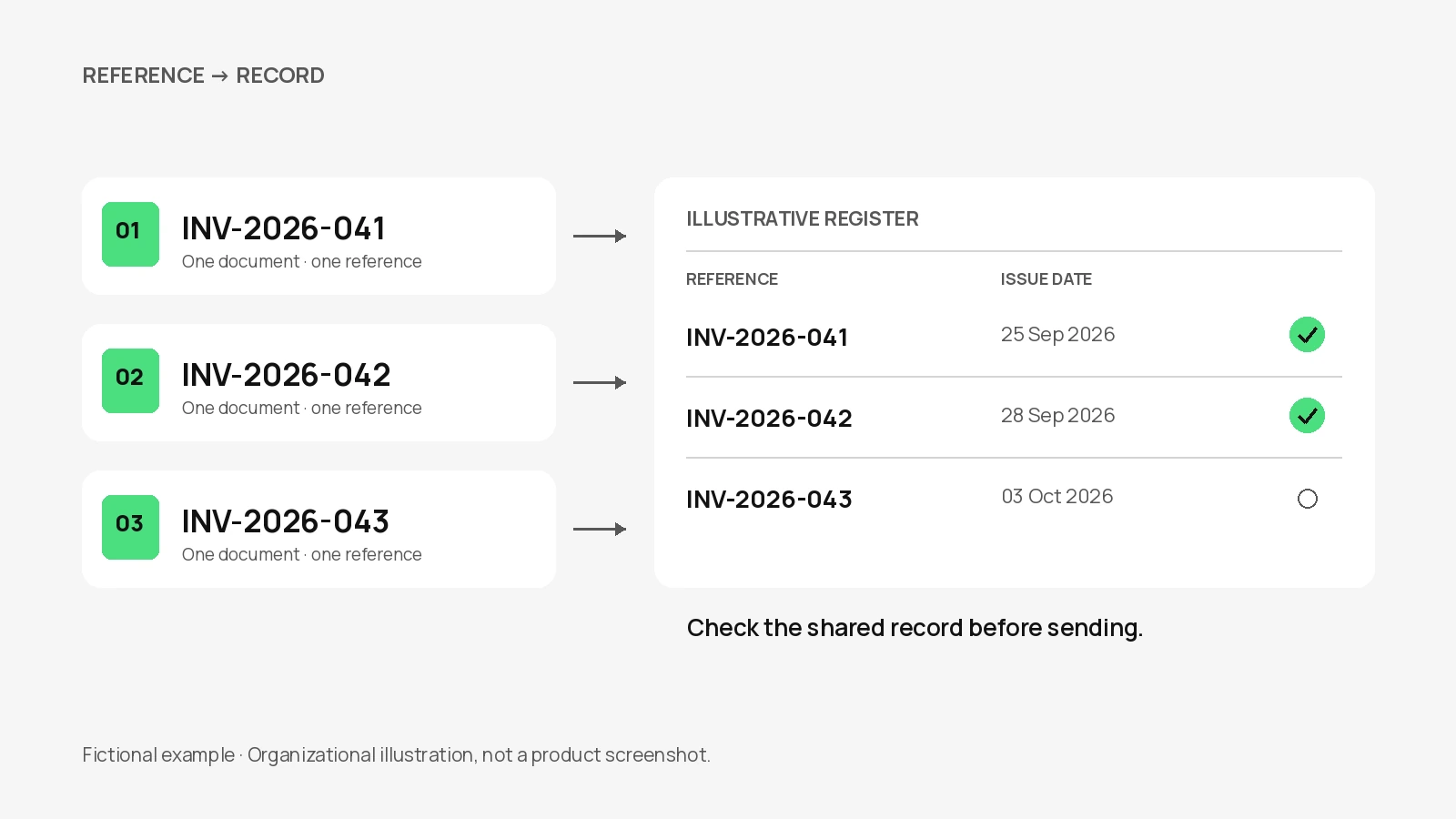
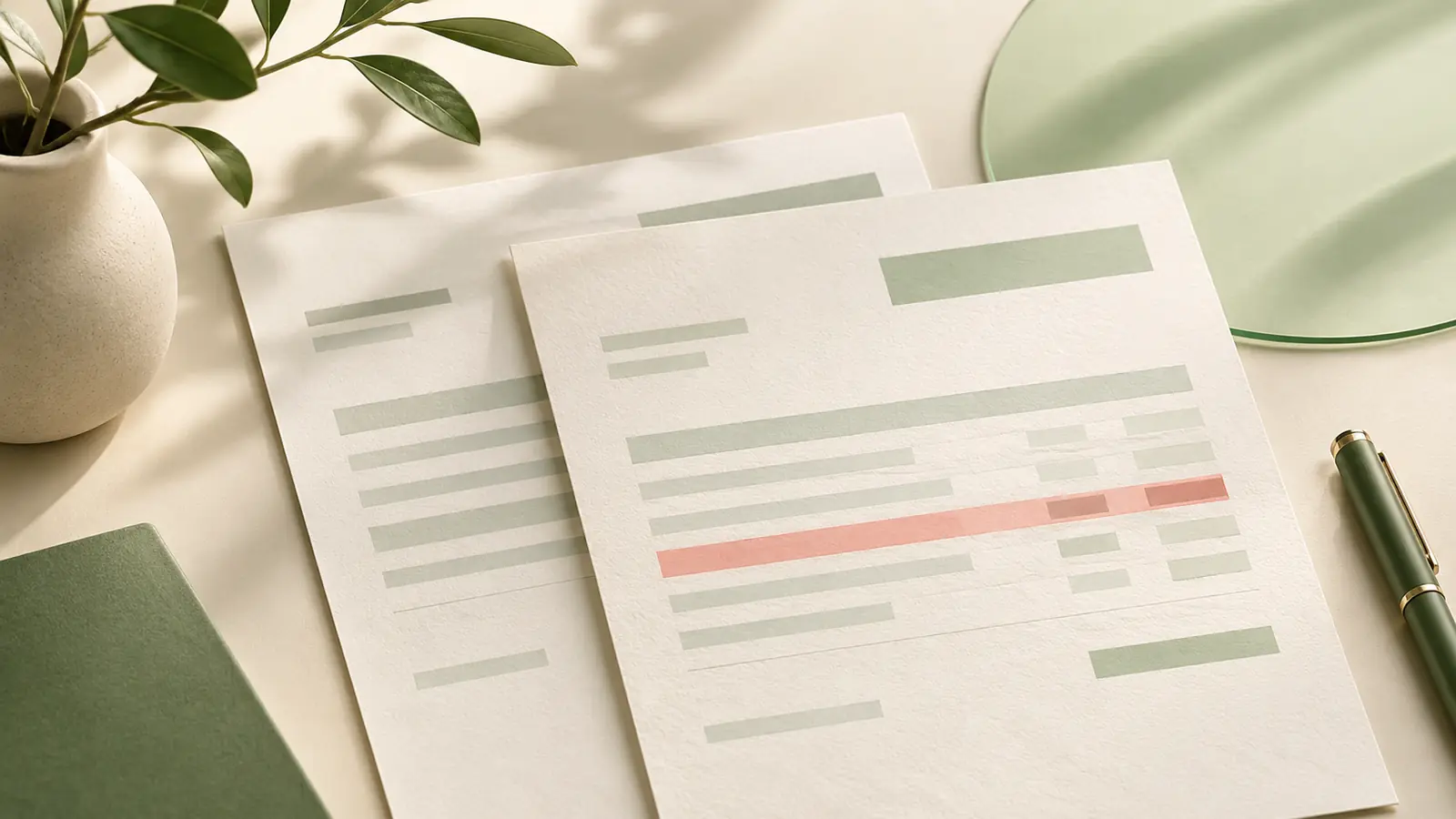
Keep the original issued invoice, identify the error and its effect, and tell the customer how it will be corrected. A revised or replacement invoice may resolve some mistakes; a genuine price reduction can require a credit note or adjustment document, while new approved work may need a separate invoice. The correct form and tax treatment depend on the jurisdiction, tax registration, original supply and whether the invoice has been posted or paid.
In this guide
Start by identifying the actual error
Once you send an invoice, it is no longer merely a document on your own computer. A copy may be sitting in a customer's inbox, their purchasing system or their tax records. Editing your PDF does not edit those copies. A correction therefore needs two things: accurate information and a traceable explanation of the change.
Ask three questions before opening an editor. What is wrong? A misspelled contact name has different consequences from an overcharge. Has anyone acted on the invoice? A bill that has been posted, part-paid or used in a VAT/GST return needs more care than an obviously incomplete attachment caught immediately. What has actually been agreed? You might be correcting a typing mistake, reducing a fee, adding newly authorized work or unwinding a cancelled transaction.
Save the originally issued version and its number. Check the accepted quote, work order, timesheet, delivery evidence, correspondence and bank records. Confirm which customer or legal entity was billed. A corrected description should describe the real service; it should not erase a contractual disagreement by changing words.
The IRS guidance on supporting business records lists invoices and proof of payment among the documents that support business entries. That is US tax guidance, not a universal document-retention rule, but it illustrates why keeping the original matters.
Match the problem with the right kind of correction
Different mistakes call for different decisions. The following table is a practical triage tool, not a legal rule that every country uses the same document.
| What happened | Practical starting point | What to verify |
|---|---|---|
| Wrong contact, reference or minor description; amount unchanged | Ask whether a clearly marked replacement or correction notice is suitable | Customer identity and local invoice requirements |
| Hours or price too high, goods returned or agreed reduction | Calculate the reduction and check credit-note/adjustment requirements | Original tax treatment and whether it was already reported |
| Additional work expressly approved later | Explain and document the new charge separately | Approval evidence and correct invoice/debit format |
| Duplicate invoice sent | Determine what was actually booked or paid and identify the duplicate | Number sequence, customer ledger and tax filings |
| Transaction cancelled | Reconcile work delivered, deposits, refunds and the agreement | Contract terms and tax adjustments |
| A payment was received but the original bill was correct | Record the payment, not a fictitious reduction to the service price | Confirmed bank transaction and payment allocation |
UK HMRC explains that credit and debit notes can document corrections or changes in consideration. Australia uses adjustment notes in relevant GST circumstances. Canada's GST/HST rules prescribe information for credit and debit notes. These are different systems. If you are tax-registered, a new PDF alone may not be a lawful substitute for a required tax document.
Recalculate the invoice before issuing anything
A fictional design business, Cedar Studio, sent invoice INV-2026-084 to Pine Retail. The bill charged eight hours of design work at $95 per hour plus $120 of agreed production expenses. Reviewing an approved timesheet, both sides find that only six hours were delivered. The expenses were correct.
| Item | Originally charged | Verified amount | Change |
|---|---|---|---|
| Design labor | 8 × $95 = $760 | 6 × $95 = $570 | −$190 |
| Approved expenses | $120 | $120 | $0 |
| Total before any tax | $880 | $690 | −$190 |
This illustration is before any applicable sales tax, VAT or GST. The arithmetic proves a $190 commercial difference. It does not by itself decide what tax document should be issued.
Suppose Pine Retail also paid $300 against this invoice. The reconciliation is:
- Original pre-tax charge: $880.
- Confirmed reduction: $190.
- Corrected pre-tax charge: $690.
- Actual customer payment: $300.
- Remaining commercial balance, before any applicable tax adjustment: $390.
Check it two ways: $880 − $190 − $300 = $390, and $690 − $300 = $390. A payment is not a second discount; it is money received. Recording a second $690 invoice without also dealing with the original $880 could leave two debts in the customer's accounts. Do not assume a new PDF automatically reverses the first posting.
If tax is involved, ask the responsible bookkeeper or accountant to reconcile the tax and any reported return as well as the commercial balance. A fictional tax-exclusive example should not be silently converted into a compliant invoice for every country.
A detail correction need not change the price
A buyer's internal purchase-order reference, a spelling error, an incomplete billing address or an overly broad description may be wrong even while the quantities and agreed charge are right.
Make the change understandable. Identify the original invoice number and issue date, state that the amount is unchanged and show exactly which detail is corrected. Retain both copies. For example:
Subject: Corrected reference on INV-2026-084. Please use the attached corrected copy for your records. The purchase-order reference is PO-091, not PO-019. No services, amounts or payment terms have changed. We have kept the originally issued version with this correction notice.
That is more useful than sending an unexplained attachment named FINAL-NEW-2. If the customer's accounting team has already posted the bill, ask it which form it needs.
Even supposedly minor changes can matter. Changing a customer from one legal entity to another may change the person liable to pay. Changing a VAT registration detail or service date may affect tax validity. Do not use the phrase "minor correction" as a reason to bypass country-specific requirements.
When a credit note or adjustment note matters
A credit note commonly documents a reduction of a previously invoiced charge. Examples include returned goods, a genuine overcharge or an agreed price reduction. It is not the same as a refund. A credit might reduce an open balance or accompany a separate money transfer.
The governing rules are specific. HMRC's conditions for UK VAT credit notes include a genuine correction or price reduction. HMRC VAT error guidance distinguishes mistakes in a bill to a customer from reporting mistakes. The Canada Revenue Agency's section 232 memorandum sets out prescribed information for GST/HST notes. The ATO adjustment-note ruling has separate Australian requirements.
Do not take a foreign country's form, change the currency sign and assume it is valid where you operate. Tax status, the original supply and reporting period affect the result.
The released free NineBrief tools create Invoice, Quote/Estimate, Purchase Order and Delivery Note documents. This article does not claim a dedicated credit-note generator, tax-return adjustment feature or automated customer ledger. Where a compliant credit/debit/adjustment note is required, use an appropriate accounting workflow.
Deal with duplicate invoices before they become double charges
Two emails can contain the same invoice attachment without creating two separate sales. But two independently numbered invoices for one job can produce duplicate bookkeeping, payment requests or tax entries.
Compare the billed customer, work period, purchase-order reference, amount and document numbers. Determine which version was actually issued, received, posted or paid. Inform the customer's accounts team which invoice is valid and what it should do with the duplicate, subject to its accounting process and local rules.
Keep a cancellation or cross-reference trail rather than recycling a duplicate number for another customer. How to number invoices covers why stable references help your records. If the customer paid both bills, the next task includes reconciling two confirmed bank receipts and arranging the appropriate credit or refund. Never state that a refund has happened merely because you changed an invoice.
What if the invoice was already paid or reported for tax?
The billed amount, amount still owed and money that has actually moved are three different quantities. A tax return creates a fourth record. Changing one does not automatically update the others.
If payment has arrived, verify its source, date, currency and reference. Allocate it to the correct invoice in your records. A subsequent commercial reduction may create a refund or customer credit rather than an amount still due. If a tax return already included the original transaction, the person responsible for filing should determine how an adjustment is reported.
The IRS describes supporting documents and books in its small-business record guidance. The UK publishes specialized VAT error-correction rules. You cannot infer one system's treatment from the other.
Keep the original invoice, correction document, customer notice, bank proof and relevant ledger/filing note together. Organizing invoices and receipts provides a separate filing approach.
A complete customer correction message
A customer should not need to guess whether it has a new bill, a replacement, a reduction or merely a corrected name. State the reference, the change, the amount, what you attached and any payment instruction.
For the fictional Cedar Studio case:
Subject: Invoice INV-2026-084 — confirmed billing correction
We reviewed the timesheet and confirmed six design hours rather than eight. The pre-tax charge therefore decreases by $190, from $880 to $690. We have separately confirmed your $300 payment, leaving a pre-tax commercial balance of $390. Please retain the original invoice with the appropriate correction document supplied for this adjustment. Let us know if your accounts team requires a particular reference before posting it.
The phrase "appropriate correction document" is deliberate: a tax note should not be claimed to exist until it has actually been prepared. Do not add a new due date or late fee without checking the agreement and applicable law.
If a buyer disputes work quality or scope, handle that dispute separately instead of quietly revising the description until it looks undisputed.
Maintain a small correction register
A modest business can use a simple register to identify what happened, provided its accounting records also comply with the rules that apply to it.
| Field | Example |
|---|---|
| Original invoice | INV-2026-084 |
| Original date | 4 November 2026 |
| Original charge before tax | $880 |
| Verified error | Two design hours charged in error |
| Agreed reduction | $190 before tax |
| Revised commercial charge | $690 before tax |
| Confirmed payment | $300 |
| Remaining before tax adjustment | $390 |
| Required correction document | Confirm type and number for jurisdiction |
| Customer communication | Record the recipient and actual send date |
| Tax reporting | Record review and actual adjustment if applicable |
Attach the issued PDF, updated record, proof of approval or correction agreement and bank evidence. The register should make it possible for someone unfamiliar with the job to arrive at the same figures.
An audit trail does not mean copying private customer information into public analytics or a third-party AI prompt. Keep business records in your own approved storage and follow privacy requirements.
Use the appropriate NineBrief workflow
The free Invoice Generator lets you prepare an ordinary invoice with its itemized charges and customer information. It is suitable for a corrected or replacement ordinary invoice only when that document type is right for the transaction. Save the original PDF and editable source outside the working browser state before you revise anything important.
Do not assume that putting a negative line on a conventional invoice produces a legally compliant credit note. Do not assume NineBrief sends correction messages, updates bank transactions, records refunds or files VAT/GST amendments. Those are separate operations.
For initial invoice fields, read how to create an invoice. For actual payment terms, use invoice payment terms, not a new rule inserted during a dispute.
Questions businesses ask after an invoice mistake
Can I delete the wrong invoice?
A working draft can often be discarded, but an already issued invoice should usually remain traceable. Whether a particular business must retain a cancelled invoice or issue a separate reversal document depends on its records and law.
Can I use the same invoice number?
A corrected copy may reference the original number while a credit or new supplementary document may need its own reference. There is no single worldwide numbering rule. Keep the relationship explicit.
Is a credit note proof of a refund?
No. A credit note documents a credit or adjustment; a refund is money actually sent. Retain payment evidence separately.
What if the customer paid the wrong total?
Reconcile the correct commercial amount against the bank receipt, then document any additional payment, refund or credit actually due. Do not mark a transaction settled until it has been checked.
What if I billed too little?
Confirm the original agreement and whether additional work was authorized, then check whether a supplementary invoice or debit/adjustment document is appropriate. A quiet overwrite can create two contradictory records.
Can NineBrief correct my accounting records?
No. The released document generator prepares invoices. It is not a full accounting, tax-return or credit-note correction system.
Final correction checklist
- Preserve the exact originally issued invoice and its issue evidence.
- Identify whether the change affects the customer, supply, amount, tax or only a detail.
- Verify the agreement, work record, deliveries and approved quantities.
- Recalculate all affected charges and confirmed payments independently.
- Select the document type required by the jurisdiction and transaction.
- Give the customer the original reference and an unambiguous explanation.
- Reconcile payment, refund or credit amounts against actual bank evidence.
- Retain the original, correction, correspondence and tax/accounting outcome.
- Confirm the customer's records and your own ledger no longer show duplicate debt.
The point of a good correction is not to make the mistake disappear. It is to leave a clear record of what was billed, why it changed and what remains owed.
About this resource
Product instructions are based on the current free-tool implementation; examples are synthetic and their arithmetic is checked. This is practical product guidance, not professional legal, tax or accounting advice.
For how the tools operate, see the Free Tools Terms of Use and Privacy Policy. Send corrections to hello@ninebrief.com without including confidential customer documents.