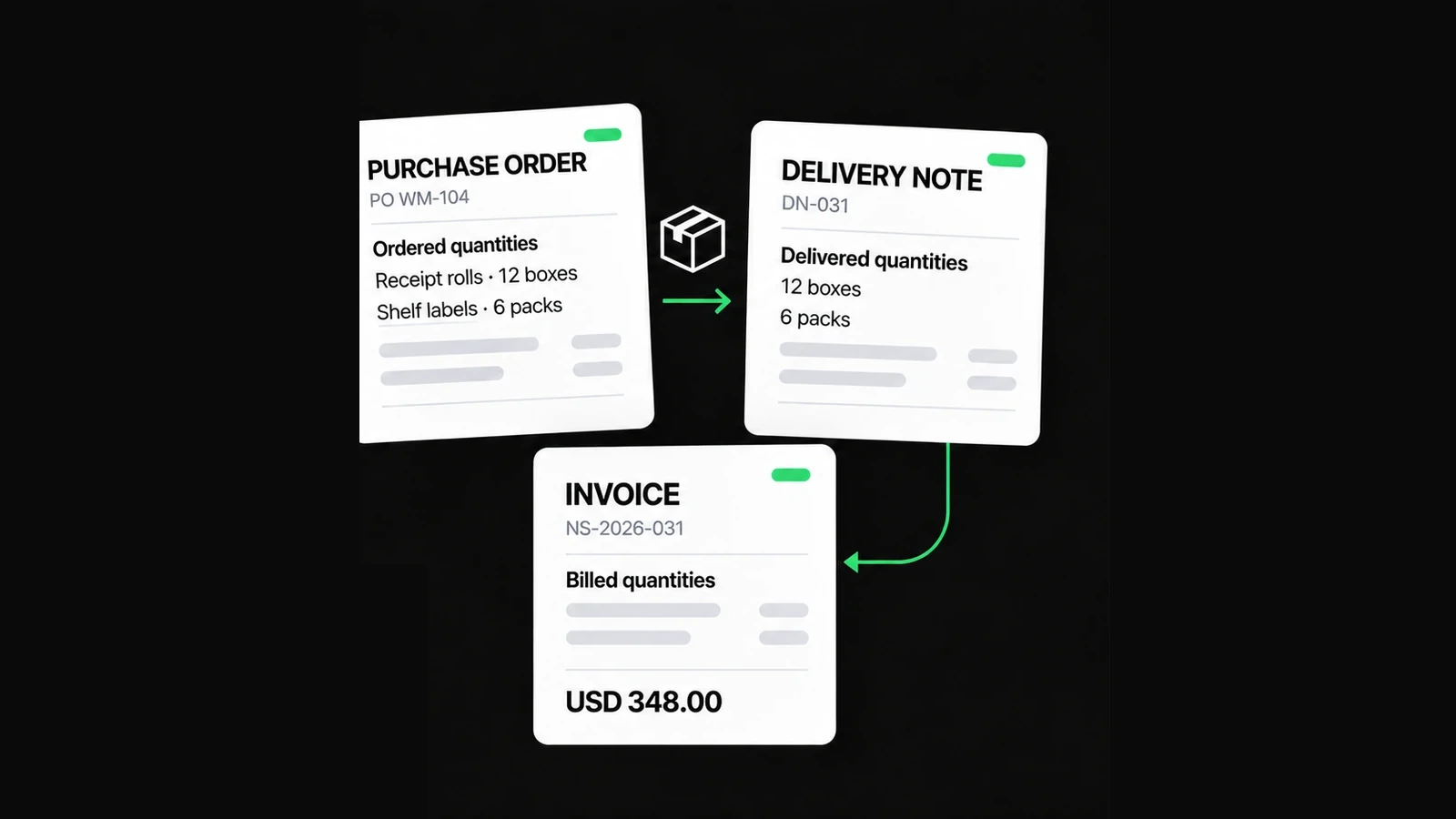
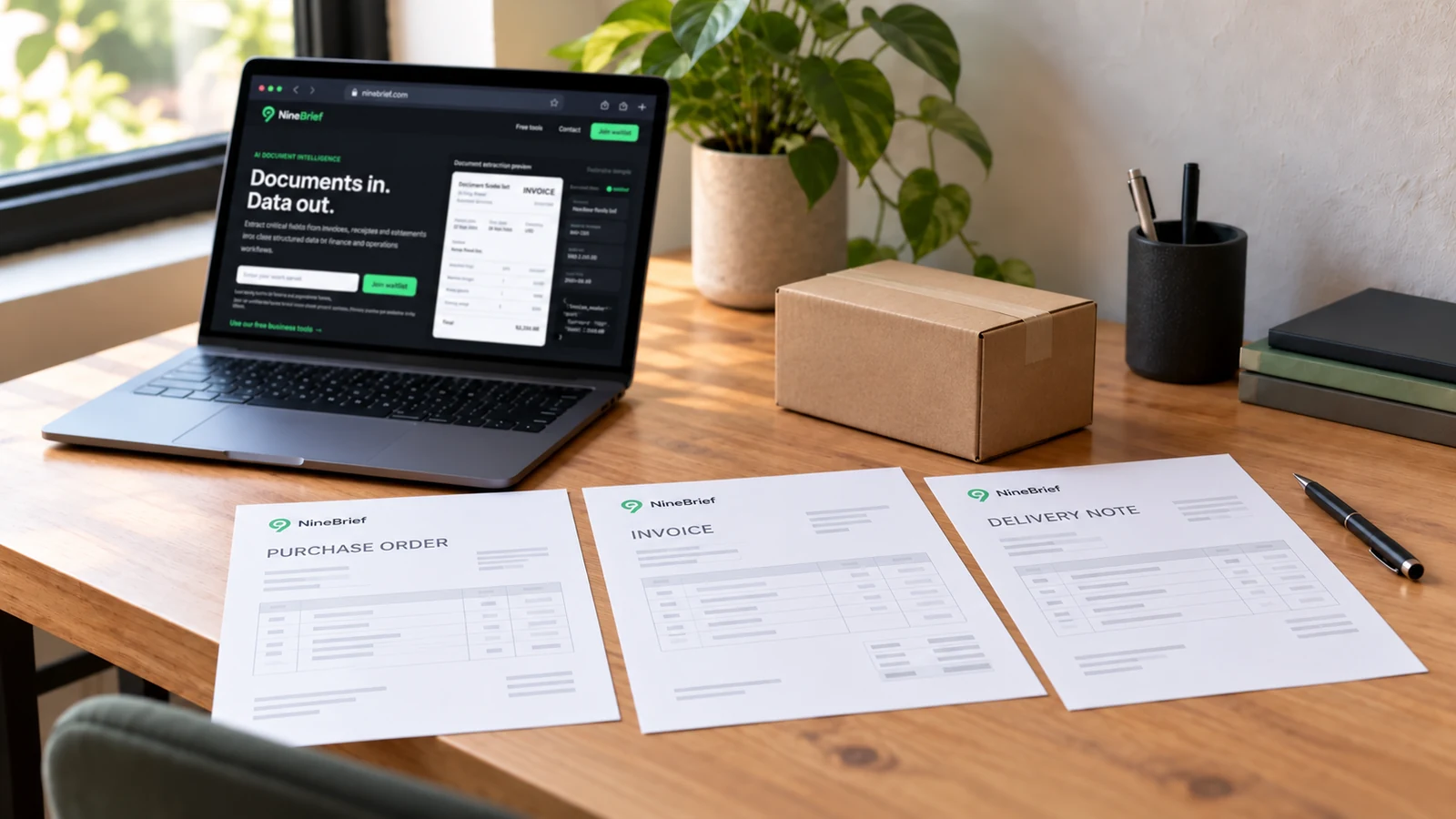
A purchase order usually comes from the buyer and records what they want to order. An invoice usually comes from the supplier and records what they are billing. A delivery note accompanies or records a particular shipment and lists its goods and quantities.
In this guide
The differences at a glance
In an ordinary buyer-to-supplier sale, the roles look like this:
| Document | Usually prepared by | Sent to | Main question it answers |
|---|---|---|---|
| Purchase order, or PO | Buyer | Supplier | What are we ordering, at what agreed price and on what terms? |
| Invoice | Supplier | Buyer’s billing contact | What are you charging us for, and what is payable? |
| Delivery note | Supplier or dispatch team | Delivery recipient | What is included in this shipment? |
The Association of Accounting Technicians’ explanation of sales and purchase paperwork uses these buyer/supplier distinctions. It also separates the buyer’s goods received note from the supplier’s delivery note.
Names vary. You may encounter delivery docket in Australia and packing slip in Canada or the USA. Check the contents and purpose rather than assuming every business uses those labels identically. A packing list, carrier document or customer-specific receiving form may contain additional information.
What the buyer puts on a purchase order
A useful PO makes the order identifiable before the supplier prepares it. Include the buyer and supplier, a PO number, product or service descriptions, quantities, units, agreed prices, currency and relevant delivery instructions.
Be precise about units. “20 crates” and “20 packs of crates” can represent very different orders. If size, colour or a product code identifies the goods, include it consistently.
Separate the billing address from the delivery destination. A head office may pay while a warehouse receives. Tell the supplier which contact handles order changes and which contact handles invoices.
Ask the supplier to confirm the order and any changes through your agreed process. Sending a PO does not, by itself, prove that the supplier has accepted every detail. This guide explains document roles; it does not determine whether a particular order creates an enforceable contract.
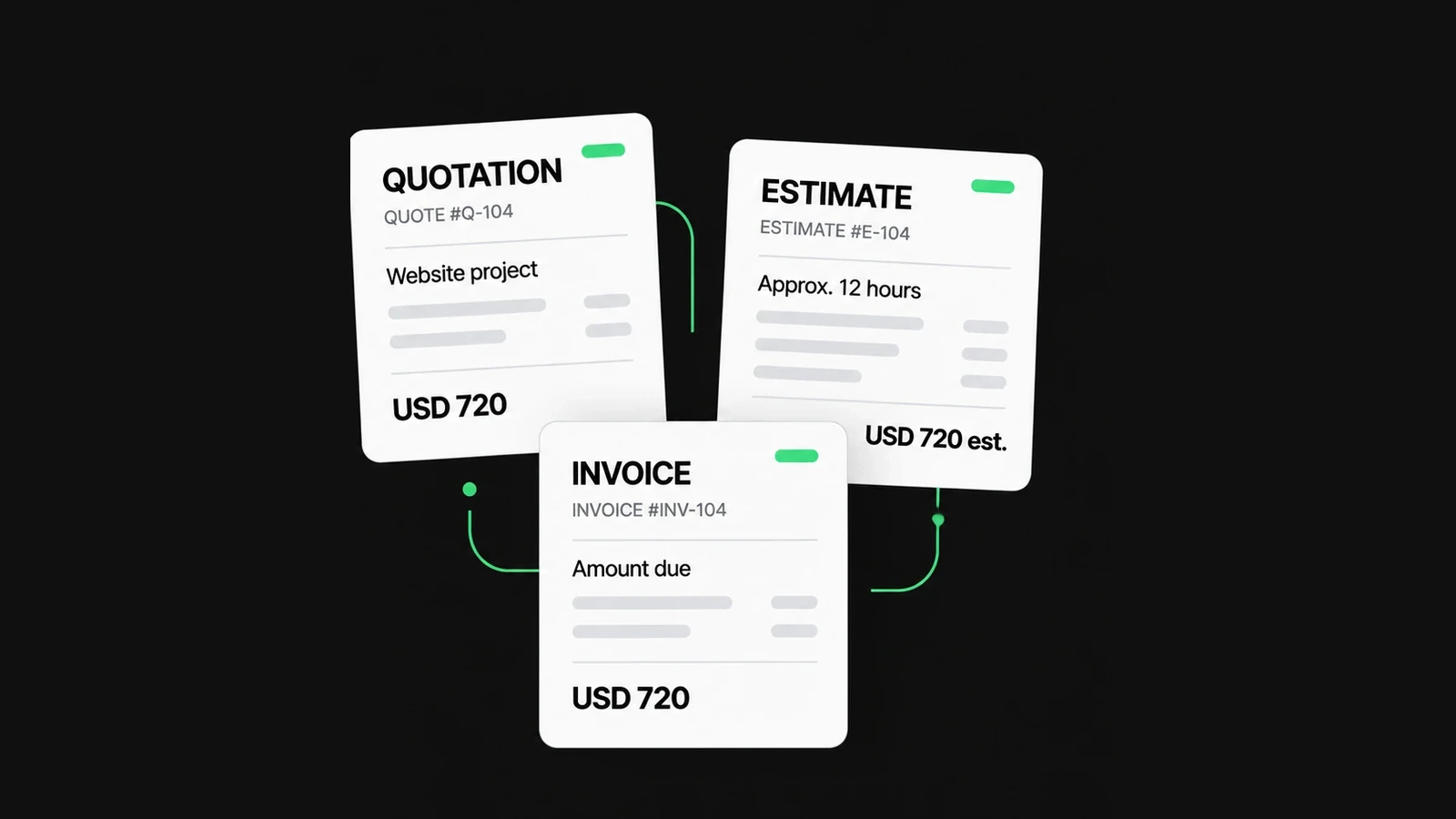
Before this stage, a supplier may have sent a quotation. Our quotation, estimate or invoice guide explains that earlier pricing decision.
What the supplier puts on an invoice
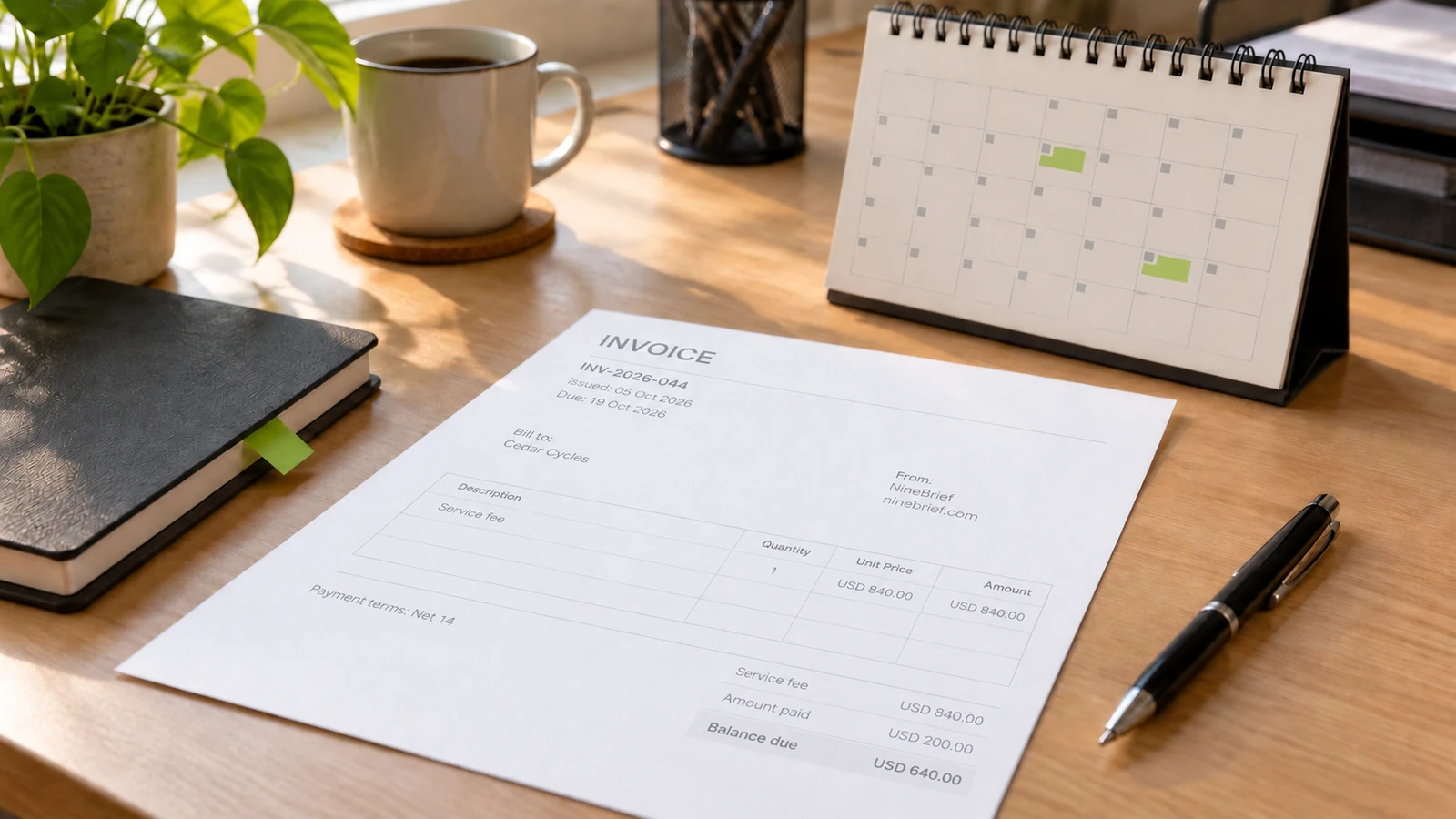
An invoice should make the current charge understandable. Identify the supplier, billing customer, invoice number, issue date, relevant supply date or service period, descriptions, billed quantities, rates and applicable adjustments. Show the payable amount and the agreed payment instructions.
Include the customer’s PO reference when supplied. The invoice number identifies your bill; the PO number identifies the customer’s order. They should not be treated as interchangeable references.
Billing timing follows the agreement and applicable rules. An invoice may relate to an agreed advance payment, a completed delivery, a milestone or a billing period. It is misleading to assume that every invoice must wait until all goods have arrived.
An invoice is also different from evidence of payment. A charge being billed does not establish that funds were received. Keep payment records separately and apply received payments to the correct bill.
Use a reference register across your issuing devices. The invoice numbering guide explains how to reduce duplicate references.
What belongs on a delivery note
A delivery note should describe the particular shipment. Include the sender, recipient, delivery location, document number, relevant order reference, delivery date, item descriptions and stated delivery quantities.
Do not copy the full ordered quantity into a delivery note when only part of the order is being sent. Do not use an expected delivery date as though it proves a completed handover.
A nonfinancial delivery note can omit prices and payment details, allowing receiving staff to concentrate on checking the goods. It serves a different purpose from the invoice, even if the documents travel together.
At receipt, compare the shipment with the note. Record shortages, damage or substitutions and keep the receiving record. A supplier’s prepared note is not independent confirmation that the buyer received or accepted everything.
A signature or acknowledgment can form part of the receiving evidence, but it does not answer every question about price, condition or payment.
Worked example: 20 ordered, eight delivered, eight billed
Imagine Pine Street Retail ordering storage crates from Brook Lane Supplies. Both businesses, all references and all amounts below are fictional.
The parties agree to deliver the order in two batches and bill the accepted goods after each delivery. Each crate costs GBP 24.00. Tax, discounts, carriage charges and payments are omitted to isolate the quantities and arithmetic; this is not a complete tax invoice or a reason to omit applicable tax.
| Record | Reference and date | Quantity represented | Calculation |
|---|---|---|---|
| Buyer’s purchase order | PO-2026-081, 12 October 2026 | 20 crates ordered | 20 × GBP 24.00 = GBP 480.00 |
| First delivery note | DN-2026-031, 13 October 2026 | Eight crates in the first shipment | No financial total |
| First invoice | INV-2026-061, 13 October 2026 | Eight accepted crates billed | 8 × GBP 24.00 = GBP 192.00 |
| Second delivery note | DN-2026-032, 20 October 2026 | Remaining 12 crates in the second shipment | No financial total |
| Second invoice | INV-2026-062, 20 October 2026 | Remaining 12 accepted crates billed | 12 × GBP 24.00 = GBP 288.00 |
The first invoice can show the accepted eight-crate charge separately:
| Description | Quantity | Rate (GBP) | Amount (GBP) |
|---|---|---|---|
| Accepted storage crates, PO-2026-081 / DN-2026-031 | 8 crates | 24.00 | 192.00 |
After the first batch, the order remains for 20 crates, but only eight have been delivered and billed. The other 12 are still pending in the business’s own records.
After the second batch, 8 + 12 = 20 crates and GBP 192.00 + GBP 288.00 = GBP 480.00. Neither invoice bills all 20 again.
Different agreed billing terms could produce a different sequence. For example, billing the entire order in advance would not turn an eight-crate delivery into a 20-crate delivery. The commercial and physical records still need to describe their own events accurately.
Match the order, receiving evidence and bill
Checking these records together is often called three-way matching. For the first batch, compare the PO’s item and unit price, the receiving evidence for eight crates and the invoice for eight crates at that price.
This comparison is more useful than asking whether all three document totals are identical. A partial delivery can be correct even when its quantity is smaller than the order.
Suppose eight crates arrive but one is damaged. Record that distinction instead of silently treating “arrived” as “accepted.” Raise the discrepancy with the supplier and resolve the billing treatment under the agreement.
Do not overwrite issued documents merely to make the records appear to match. Retain the original records, the discrepancy and the agreed correction. Likewise, record cancellations or substitutions so a pending quantity does not remain unexplained indefinitely.
Keep dates and references specific
An order date, expected delivery date, actual delivery date, invoice issue date and payment due date describe different events. Some may coincide; none should automatically substitute for another.
For the first example invoice, assume the agreed term is 14 calendar days from the invoice date. An issue date of 13 October 2026 produces a due date of 27 October 2026. That is an example assumption, not a universal deadline.
The payment terms guide explains how to state the starting event and check the resulting date.
Use written month names and an explicit currency code when documents cross borders. “GBP 192.00, due 27 October 2026” leaves less room for confusion than an unspecified dollar sign or an ambiguous numeric date.
What businesses in the UK, Australia, Canada and USA should check
The document roles are useful across these markets, but invoice requirements need a local check.
| Market | Practical check | Primary guidance |
|---|---|---|
| UK | Include the required invoice information and check the additional requirements that apply to your business and VAT status. | GOV.UK: what invoices must include |
| Australia | Distinguish a regular invoice from a GST tax invoice. Check the correct wording, ABN and applicable tax details. | Australian Government: how to invoice |
| Canada | Provide the GST/HST information needed for your transaction and the customer’s supporting records. Requirements can depend on the amount. | CRA: records supporting input tax credits |
| USA | Keep invoices and supporting transaction/payment evidence. Check the rules relevant to your state, business and type of supply separately. | IRS: supporting business records |
The IRS reference covers federal recordkeeping; it is not a state sales-tax checklist. Readers elsewhere should use the relevant local authority rather than transplanting one country’s tax treatment.
Prepare the documents in NineBrief
Choose the generator for the document’s purpose and review each result:
- Use the Purchase Order Generator for the buyer’s order. Enter the supplier, correct units, agreed rates and delivery details.
- Use the Delivery Note Generator for the shipment. Purchase Order → Delivery Note conversion requires you to enter delivery quantities explicitly; ordered quantities are reference information.
- Use the Invoice Generator for the charge being billed. Purchase Order → Invoice conversion is available, with review of the supplier as issuer, quantities/prices, tax and charges, and separate invoice details.
- For the partial eight-crate bill in this example, prepare a separate invoice manually. The current PO → Invoice conversion copies the full reviewed order; it does not allocate partial invoices or track remaining balances.
- Review identities, addresses, quantities, dates and applicable tax before saving each PDF. Preserve an editable JSON backup when needed.
Basic document creation and PDF output do not require an account. Browser drafts and downloaded backups are not a shared cloud order register. Keep your delivery and billing reconciliation separately, and check before replacing an existing draft.
For a bill covering the movement of goods, use the transport and logistics invoice example to keep transport charges separate from the goods themselves.
Questions that come up in practice
Can an invoice replace a purchase order?
The two documents have different issuers and purposes. A supplier’s invoice does not recreate the buyer’s earlier order approval. Ask the customer whether they require a PO reference or a particular submission process.
Is a delivery note proof that the invoice has been paid?
No. It describes the shipment. Payment requires separate evidence. Neither a delivery reference nor a manually selected invoice status verifies a bank transaction.
Can one order have several delivery notes and invoices?
Yes, where the transaction and agreement call for several shipments or billing stages. Give each document its own reference, retain the common order reference and keep a record of what each document covers.
Before sending or approving the documents
- The buyer, supplier, billing customer and delivery recipient are identified correctly.
- Descriptions, product codes and units refer to the same goods.
- Ordered, shipped, received, accepted and billed quantities are distinguished where necessary.
- Partial deliveries and pending quantities have a separate record.
- Invoice timing and amounts match the agreement.
- Invoice references are allocated without duplicates.
- Due dates, currency and local tax information have been checked.
- PDF files, editable backups and relevant receiving/payment evidence are retained.
Start with the order, record the shipment that actually happened and bill according to the agreed terms. Each document becomes easier to check when it describes one clear part of the transaction.
Sources checked 9 October 2026. Examples are fictional. Local legal and tax requirements should be checked for the actual transaction.
About this resource
Product instructions are based on the current free-tool implementation; examples are synthetic and their arithmetic is checked. This is practical product guidance, not professional legal, tax or accounting advice.
For how the tools operate, see the Free Tools Terms of Use and Privacy Policy. Send corrections to hello@ninebrief.com without including confidential customer documents.