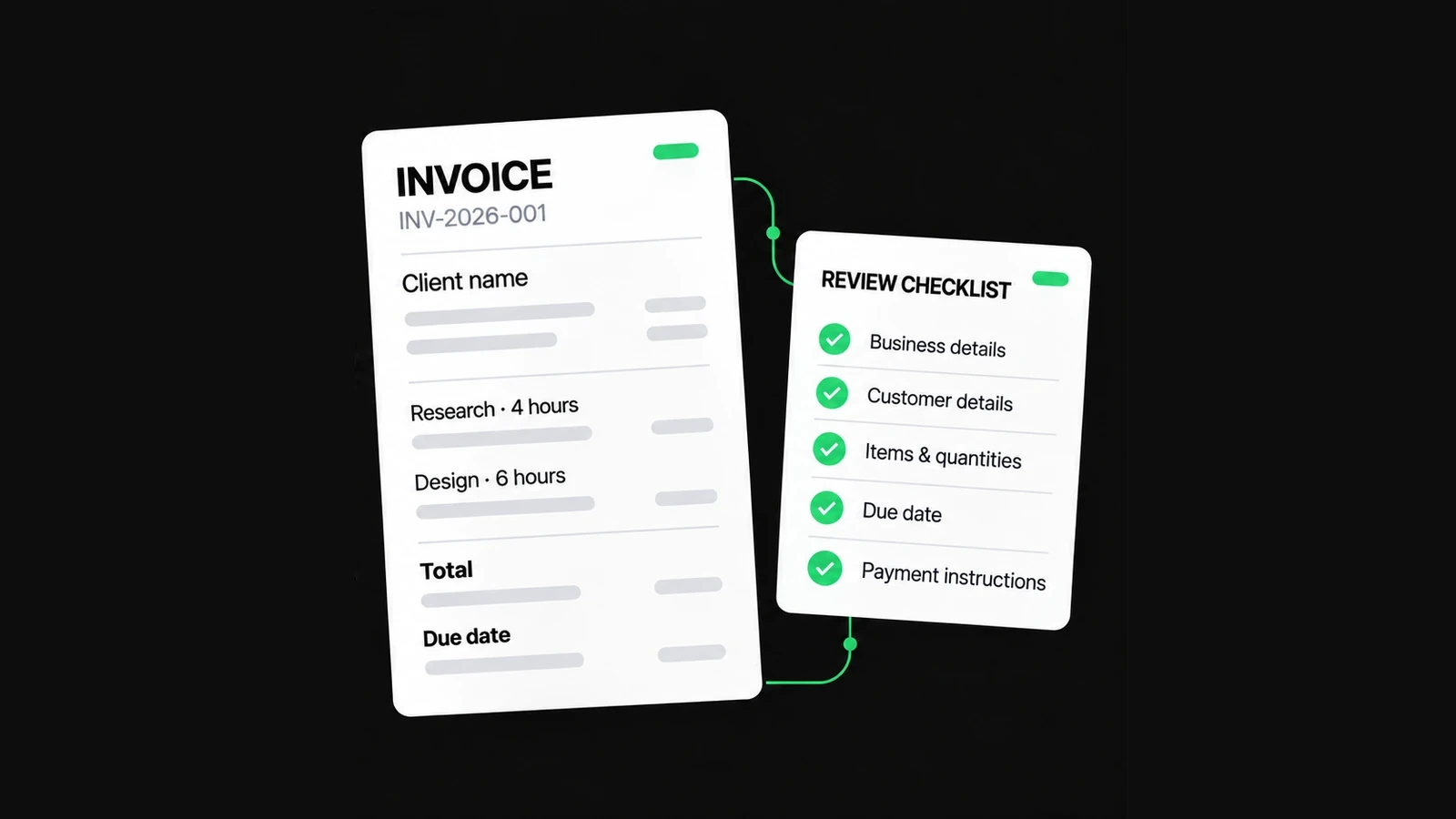
A useful transport invoice identifies the party responsible for payment, the trips or consignments being billed, the agreed charging basis and any supported extra charges. Include references that let the customer connect the bill to their booking and delivery records. Separate the transport fee from the value of goods carried, and check the tax treatment for the actual service.
In this example
Identify the payer before preparing the invoice
The person receiving the goods may not be the person paying for transport. A warehouse, retailer, freight broker or principal contractor can have different roles in the same job.
Confirm the billing customer’s legal or business name, billing address, invoice contact and required booking, PO or load reference. If a broker engaged you, do not assume the consignee becomes your customer because their staff signed at delivery.
Consignor means the party sending the goods; consignee means the receiving party. Record those roles where needed, separately from the bill-to party.
Ask where the invoice should go. A delivery contact may be unable to approve payment, and a customer may require a portal submission or supporting documents. Follow the agreed process and retain the submission record.
If you are working under a self-billing arrangement, check how billing is handled before issuing a second invoice for the same work.
Make the charging unit clear
“Transport services” gives the customer little to check. Describe the service and the unit used to calculate its price.
| Charging basis | Make clear on the bill |
|---|---|
| Fixed price per trip or consignment | Which job the fee covers and what is included |
| Per mile or kilometre | The billable distance, unit and agreed rate |
| Per hour | The chargeable hours, rate and treatment of waiting |
| Per delivery or stop | Which completed stops qualify and any separately agreed extra stops |
| Weight or volume | The relevant measurement and agreed pricing basis |
| Day or vehicle hire with driver | The covered date, duration and included work |
A mileage price and a fixed trip price are different methods. Do not charge both for the same included transport unless the agreement explicitly calls for that combination.
If your customer’s billing record uses miles, do not insert kilometres without explaining the conversion and agreed billable quantity. Use the same discipline for tonnes, kilograms, pallets or cubic metres.
Give each trip a usable reference
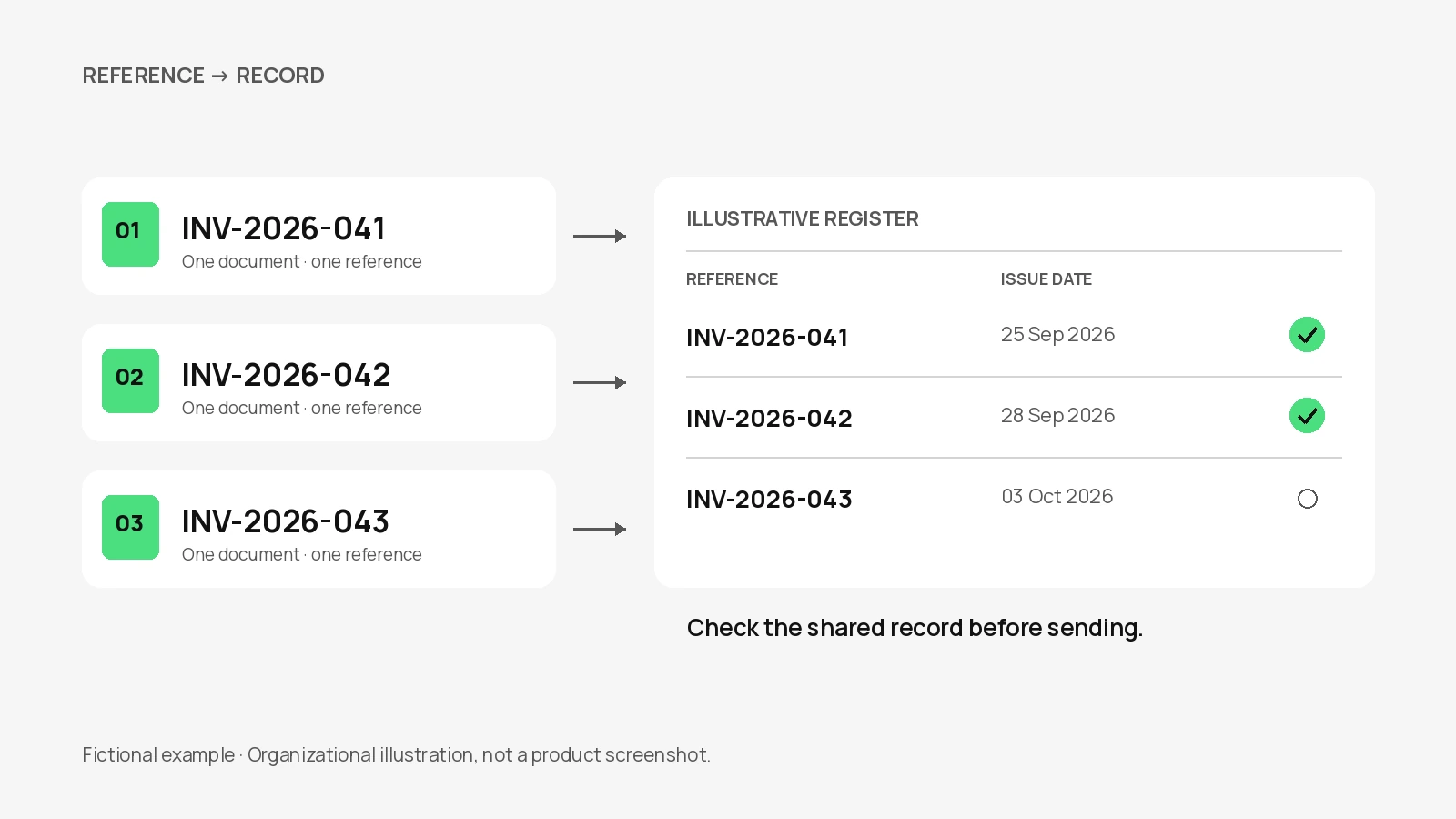
For each billed job, keep a booking or load reference, collection and delivery dates, origin and destination, and the supporting handover or delivery reference.
For a single trip, that detail may fit in the line description. For a weekly invoice, use separate lines or a clearly referenced schedule so the customer can identify the individual jobs.
A description such as “Three scheduled transfers, jobs BL-101 to BL-103, 13–15 October 2026” is more useful than “weekly deliveries.” Where routes or rates differ, list the jobs separately instead of combining them into one unexplained average.
Keep operational detail proportionate. The invoice does not need security access codes, driver identity documents or every recipient’s personal information. Put sensitive operational records in the appropriate controlled channel.
Explain additional charges and their evidence
Additional transport charges are often called accessorial charges in North American freight billing. Labels and charging rules vary between operators.
An extra charge should be traceable to an agreed trigger, a rate or amount, and evidence that it applies. Do not present example fees from an online template as industry-standard entitlements.
Waiting time or detention
Record the start and end of the relevant wait, any included allowance and the billable duration. A 75-minute wait with 30 minutes included leaves 45 billable minutes.
Check whether the agreement charges exact time, rounds to an increment or uses another rule. “Waiting: 45 minutes at GBP 40.00/hour” is reproducible; “delay fee” is not.
Fuel surcharge
State the applicable basis and calculation. A surcharge might be a fixed amount, a percentage of specified transport charges or another agreed formula.
For example, FedEx explains fuel surcharges in the context of its own shipping services. Its approach is not a rate recommendation for an independent operator. Use your agreement and the applicable schedule.
If the base fee already includes fuel, do not add fuel again without an agreed basis.
Tolls, handling and other extras
Identify the job and supporting receipt or approval. Check whether the cost was included in the base price and whether a separate charge or markup was agreed.
An incurred expense is not automatically billable to the customer. Equally, a separately agreed service fee is not necessarily a reimbursement of the exact receipt amount. Describe which treatment you are using.
Worked example: a three-trip transport invoice
Imagine Brook Lane Transport completing three depot transfers for Cedar Trade Supplies under booking CTS-2026-118. The businesses, jobs, prices and approvals are fictional; the rates are not market benchmarks.
The example agreement specifies GBP 180.00 per completed trip, an 8% fuel surcharge on base trip charges only, waiting at GBP 40.00/hour after 30 included minutes, and reimbursement of an approved toll at cost.
| Job | Service date | Route | Supporting reference |
|---|---|---|---|
| BL-101 | 13 October 2026 | North warehouse to customer depot | POD-101 |
| BL-102 | 14 October 2026 | North warehouse to customer depot | POD-102 |
| BL-103 | 15 October 2026 | North warehouse to customer depot | POD-103 |
On BL-102, the relevant waiting period is 75 minutes. Subtracting the 30-minute allowance leaves 45 minutes, or 0.75 hours. The approved toll receipt for BL-103 is GBP 18.60.
Invoice INV-2026-071, dated 16 October 2026, contains:
| Description | Quantity | Rate (GBP) | Amount (GBP) |
|---|---|---|---|
| Depot transfers BL-101–BL-103 | 3 trips | 180.00 | 540.00 |
| Agreed fuel surcharge, 8% of base trip charges | 1 charge | 43.20 | 43.20 |
| Waiting on BL-102 after included allowance | 0.75 hours | 40.00 | 30.00 |
| Approved toll, BL-103, receipt T-103 | 1 toll | 18.60 | 18.60 |
The calculation is 540.00 + 43.20 + 30.00 + 18.60 = GBP 631.80. Applying 8% to the waiting charge and toll as well would use a different basis from this example agreement.
Tax is omitted to isolate the arithmetic. Determine and add the correct tax treatment before issuing an actual invoice; the example does not establish an exemption or zero rate.
No payment has been received against this example invoice. Its pre-tax unpaid amount is therefore GBP 631.80. An advance relating to another invoice must not be deducted again.
Keep the transport bill separate from the goods documents
A supplier’s invoice can charge for the goods while a carrier’s invoice charges for moving them. Putting the goods’ sale value on the carrier’s bill as another transport line would misstate what the carrier is charging.
A delivery note or packing slip describes the shipment’s contents. Proof of delivery, often shortened to POD, is supporting delivery evidence. A bill of lading or consignment document may have additional transport-specific purposes and requirements.
These records are not interchangeable. A supplier’s delivery note does not automatically meet a carrier’s bill-of-lading requirements, and a prepared note does not establish that a recipient signed or accepted the load.
In particular, NineBrief’s delivery-note conversion uses document item quantities. If your invoice rows represent trips, waiting hours and fees, converting those rows does not produce a list of the cargo carried. Use the actual goods information for any separate goods delivery note.
Keep the booking or rate agreement, relevant delivery evidence, approved extras and invoice connected through their references. Retain the underlying records outside the invoice generator.
The purchase order, invoice and delivery note guide explains who issues each goods document and how partial deliveries differ from billing.
Check the requirements for your market
Use the example’s structure in the UK, Australia, Canada or USA, but apply the rules for your own business and service.
| Market | What needs attention | Primary guidance |
|---|---|---|
| UK | Ordinary invoice information and the VAT treatment of freight and associated services. Do not assume a cross-border journey automatically has one tax treatment. | GOV.UK invoice requirements and HMRC VAT Notice 744B |
| Australia | Regular invoice versus GST tax invoice, correct business details and the customer’s submission requirements. | Australian Government invoicing guidance |
| Canada | Applicable GST/HST and the distinction between domestic freight, qualifying international movements and other services. | CRA guidance for freight carriers |
| USA | Relevant carrier billing rules, plus tax and recordkeeping requirements for the transaction. | 49 CFR §373.103: for-hire, non-exempt expense bills |
The US freight-bill rule has a specific scope. Where applicable, it requires shipment information, assessed rates and charges, among other details; a generic invoice layout is not a substitute for checking the complete rule.
Australian Peppol eInvoicing is also different from emailing a PDF. If the customer requires a structured submission, confirm that requirement before choosing your workflow. NineBrief does not provide Peppol submission.
State the service period and payment deadline
Keep the service dates separate from the invoice date and payment due date. A weekly invoice may cover several completed trips without changing when each trip occurred.
For the example, assume 14 calendar days from 16 October 2026. The due date is 30 October 2026. If the agreement instead starts the period when a complete invoice package is received, follow that rule and retain the submission evidence.
Use the payment terms guide for clear wording. Confirm the payment reference, currency and payment instructions, and check that the invoice’s final due date matches the agreement.
Prepare the invoice in NineBrief
Open the Invoice Generator and preserve any existing draft you need. Enter the business and billing customer, a checked invoice number, currency, dates and relevant job or PO reference.
Add the transport and approved extra charges as clearly described lines. For the example, the fuel charge can be a fixed line of GBP 43.20 after you have checked its calculation; this does not claim that the tool maintains a fuel-index formula.
Review the tax treatment, adjustments and any verified payment against this invoice. Check the finished preview, save the PDF and keep an editable JSON backup. Submit the invoice and any required supporting documents through your own approved channel.
See the first-invoice guide for general fields and the numbering guide for reference allocation.
The current free tool does not provide a transport preset, dispatch management, delivery tracking, attachment storage, automated detention calculations or payment verification. It prepares the document from the information you review.
A transport invoice checklist
- The bill-to customer is distinguished from the sender and delivery recipient.
- Every billed trip or consignment is identifiable and has reached its agreed billing point.
- Quantity, distance, weight or time uses the agreed unit.
- The base price’s inclusions are clear.
- Waiting allowances and billable time are reproducible.
- Fuel surcharges use the correct agreed basis.
- Extra charges have the necessary approval or supporting evidence.
- Required delivery or transport documents are included in the submission package.
- Tax, service dates, due date, currency and current-invoice payments are checked.
- The issued PDF, editable backup and supporting records are retained.
Common billing questions
Can several trips go on one invoice?
Yes, if the customer accepts consolidated billing and the applicable rules permit your format. Keep each job identifiable. For US carriers within §373.103’s scope, check its per-shipment requirements rather than relying on consolidation alone.
Is proof of delivery proof of payment?
No. Delivery evidence concerns the handover. Keep bank, remittance or other payment evidence separately and allocate it to the correct invoice.
Can I add waiting charges after the trip?
Check the agreement, the event and the evidence. A delay alone does not explain the rate or establish that your proposed fee applies. Resolve an unagreed charge with the customer rather than presenting it as an automatic standard.
Sources checked 9 October 2026. Worked prices and references are fictional. Check applicable legal, tax and carrier requirements for the actual transaction.
About this resource
Product instructions are based on the current free-tool implementation; examples are synthetic and their arithmetic is checked. This is practical product guidance, not professional legal, tax or accounting advice.
For how the tools operate, see the Free Tools Terms of Use and Privacy Policy. Send corrections to hello@ninebrief.com without including confidential customer documents.