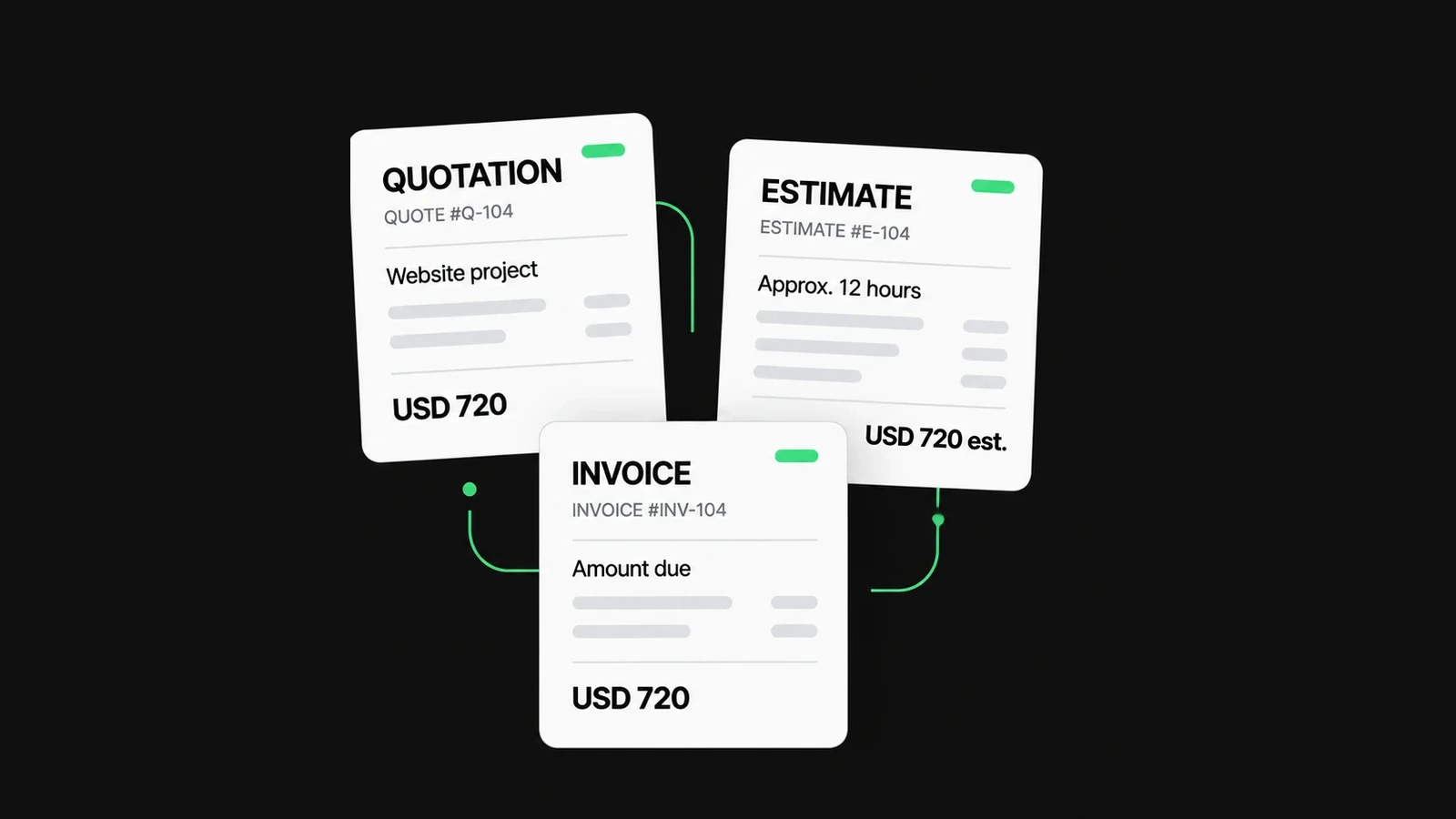

Anchor the event-planning invoice to the signed brief, venue/date and accepted scope. Itemize planning deliverables, onsite coordination time, any agreed subcontractor or vendor recharge, and authorized changes. Distinguish the planner's fee from costs that a venue or supplier bills directly; reconcile deposits against receipts rather than silently subtracting them from the contracted price.
In this example
Begin with the event brief, not a generic fee list
An event planner can organize a corporate workshop, a community fundraiser, a private celebration or a product launch. What matters for invoicing is who engaged the planner, which services were promised, and whether the work occurred or a contractual milestone became payable.
A useful invoice reference might be "Conference C-208 | Harbour Hall | 17 October | coordination services." That helps the finance contact match the document to the actual event without listing guests, individual attendees, personal addresses or private ticket details.
Compare the final invoice against the accepted proposal, service agreement, vendor purchase orders and documented changes. The Australian government's quoting guidance recommends clearly itemized costs, work dates, variations, payment terms and customer acceptance. A quote can describe a future event; the eventual invoice should describe the service or milestone being charged in accordance with the agreement.
Know whose bill each supplier owns
An event is a collection of contracts. The venue might charge the organizer directly for room rental; a caterer might issue its own invoice to the client; the planner might contract with an audiovisual technician and recharge that expense under an agreed arrangement.
Do not combine those as though the planner supplied everything. For every vendor cost ask: who contracted with the supplier, who is legally liable to pay, and did the client approve the planner's recharge? If the client pays the venue directly, a planner should not add the venue's entire bill to their own invoice merely because they coordinated the booking.
If the planner did buy a service on the client's behalf and agreed to recharge it, label the supplier item and the agreed basis, retain the supplier invoice, and follow local tax and agency/accounting rules. A reimbursable pass-through, an agency purchase and a service resale may not have identical accounting treatment. The example below avoids claiming they do.
When comparing with NineBrief's catering invoice example, remember that catering and event coordination are separate services even when they occur at the same venue.
Split fixed-fee deliverables and actual onsite time
A planner may price the project in phases: initial scope and concept, supplier coordination, event-day execution, and wrap-up. Some contracts instead price hours or a fixed inclusive event package. Use the actual contracted model rather than adding a flat coordination fee and the same hours again.
Examples of clear lines include "Approved venue coordination and running order, fixed deliverable" and "Two onsite coordinators × six hours." "Management fee" alone is difficult to audit unless it connects to a described service.
If a contract includes an eight-hour onsite block, an additional hour might be billable only if the agreed overtime or variation rule applies. Document the extra time and authorization first. If the work never occurred, do not show it as completed just because staff were reserved.
Use a preparation list outside the invoice to track suppliers, load-in windows, permits, handover contacts and arrival times; the invoice need only reference the relevant completed service or separately billable item.
A checked $2,400 conference-coordination invoice
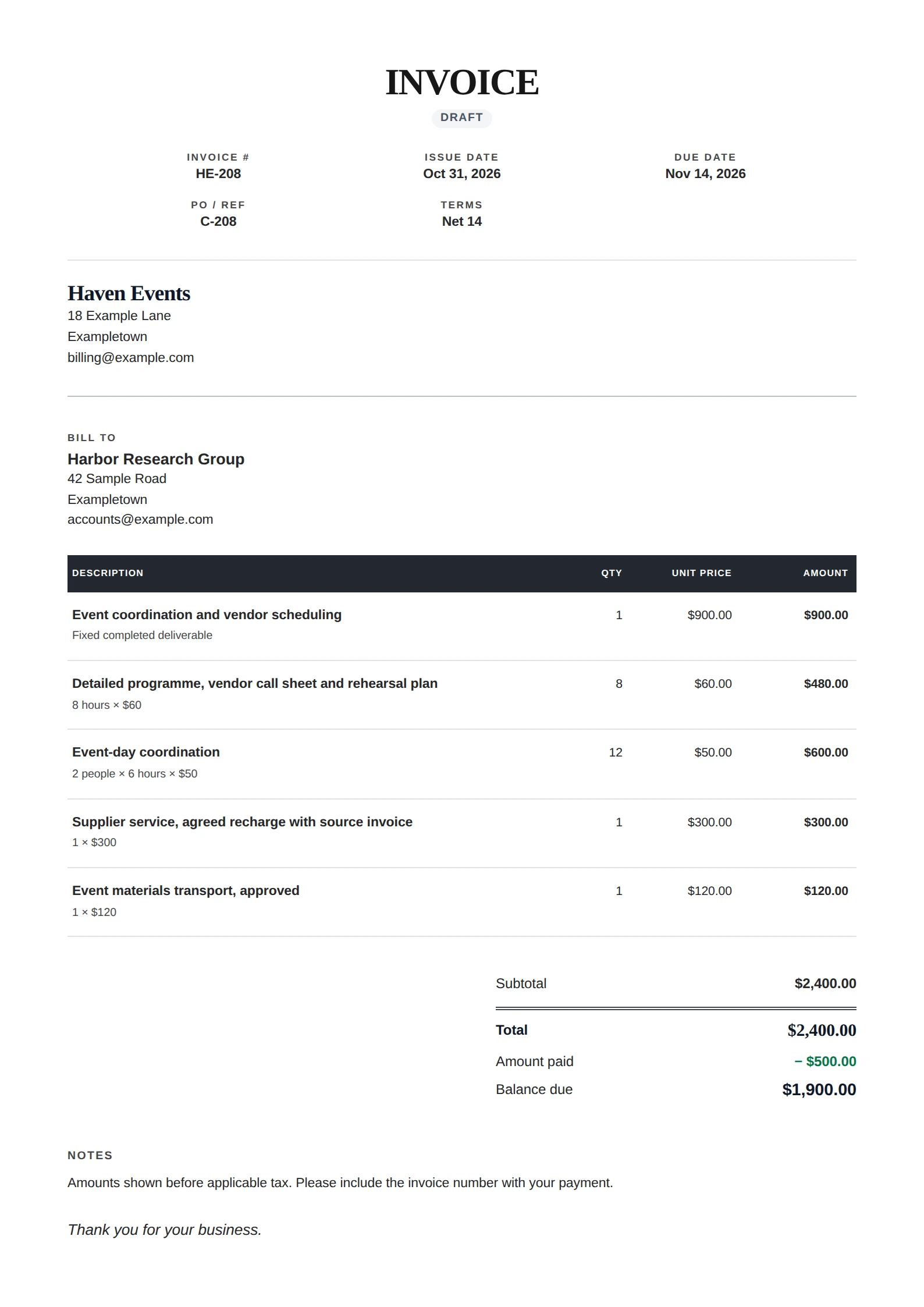
For this fictional example, Haven Events supports a single-day corporate conference for Harbor Research Group. The client accepted a fixed coordination scope, separate timeline planning, two onsite staff members, a supplier cost that Haven is contractually allowed to recharge, and event materials transport.
| Agreed service or cost | Quantity and rate | Charge |
|---|---|---|
| Event coordination and vendor scheduling | Fixed completed deliverable | $900 |
| Detailed programme, vendor call sheet and rehearsal plan | 8 hours × $60 | $480 |
| Event-day coordination | 2 people × 6 hours × $50 | $600 |
| Supplier service, agreed recharge with source invoice | 1 × $300 | $300 |
| Event materials transport, approved | 1 × $120 | $120 |
| Total before applicable tax | $2,400 |
The arithmetic is deliberate: 8 × $60 = $480 and 2 × 6 × $50 = $600. Therefore $900 + $480 + $600 + $300 + $120 = $2,400. The supplier recharge is shown only because the fictional client expressly approved it. If the supplier had billed Harbor Research Group directly, the $300 would be excluded and Haven's invoice would instead total $2,100.
The amounts are synthetic US dollars before any tax. They do not suggest typical planner prices, payroll rates, permissible agency markups or how tax must apply to a particular supplier cost.
Suppose the client previously paid a confirmed $500 advance against this event. The agreed charges remain $2,400 before tax; the commercial amount still outstanding would be $1,900 only after checking that the advance was received, attributable to this contract and properly allocated. Preserve the payment receipt. NineBrief's deposit guide covers this separation.
 View full-size image
Created in NineBrief: USD 2,400.00 before applicable tax; USD 500.00 example advance; USD 1,900.00 balance due.
- Two coordinators working six hours become twelve coordinator-hours.
- The supplier charge appears only because its recharge was approved.
- The advance is a payment allocation, not a discount on the services.
Keep event changes visible and approved
Events often change. The organizer might add a breakout room, request extra rehearsal time, alter the guest count or arrange a late supplier delivery. These changes can alter the fee, but a text message asking whether something is possible is not automatically approval to buy it.
Use a change record with the original scope, proposed change, expected amount, approval date and actual delivery evidence. Then describe the completed change in the invoice with its reference. If the client declined the extra crew member, the proposed extra hour is not a completed charge.
A cancellation or event reschedule is a different decision from an approved variation. Do not classify every cancelled event as "100% planning fee earned." In the UK, the Competition and Markets Authority warns about unfair consumer cancellation terms, especially blanket non-refundable payments. The UK's fair-contract guidance says retained deposits and charges should reflect reasonable losses and the circumstances. Those sources cover consumer contracts, not every B2B event deal or other jurisdiction.
Deposits, cancellation fees and credits are not one line
An upfront booking payment may be an advance against agreed services, a genuine reservation charge, or something else under the contract and local law. The description and treatment matter. Keep a separate record of receipt date, payment reference, what it was for, and any refund or credit decision.
When an event is postponed, compare work already completed against what can be reused: venue research, a completed production plan and rescheduled supplier deposits may each have different outcomes. Record an agreement to move unused credit to a new event instead of silently charging the customer twice.
Do not promise that "non-refundable" on an invoice automatically overrides consumer rights. The governing agreement and law must be reviewed; the invoice cannot decide a disputed cancellation entitlement by itself.
The same caution applies to "rush" or "after-hours" costs. They should be disclosed and approved rather than invented on the final day.
A vendor reconciliation that finance teams can follow
Before issuing the final invoice, maintain a vendor table outside the billing document: provider, contract party, approved quote, purchase order, delivery confirmation, who paid and any allowed recharge. This avoids presenting an organizer's project budget as the organizer's revenue.
If the event brief lists five suppliers, the final planner invoice might have only one valid recharge. That is fine. More rows do not make an invoice more professional.
Where goods are delivered and accepted separately, preserve the supplier's delivery or receiving evidence as appropriate. NineBrief's purchase order, invoice and delivery-note guide explains the roles of these records. It does not turn the public Invoice Generator into a vendor ledger or procurement system.
Document what was completed and handed over
At closeout, the planner may provide a final run-of-show, supplier contact log, staffing report, equipment return checklist and approved expense reconciliation. Identify the deliverable in the invoice, but do not include private attendee data in a public description.
Distinguish planned and completed tasks. If the venue was held for a proposed date but the event has not happened, use wording matching the lawful contractual milestone being invoiced, not "onsite coordination delivered" in advance.
If an organizer disputes a line, check evidence and issue an appropriate documented correction. Preserving both the issued invoice and agreed amendments is more reliable than overwriting a previously sent PDF.
Regional invoice and tax boundaries
The UK's ordinary invoice checklist includes unique identification, supply date, price and any applicable VAT. The ATO's invoice guidance distinguishes Australian GST-registered tax invoices. Canada's CRA explains GST/HST invoice disclosure. The US IRS emphasizes keeping invoices and underlying supporting documents.
These sources do not establish one universal tax rate for events, one rule for cross-border vendors or whether a given expense is an agency disbursement. Verify seller status, place of supply, consumer/B2B contract and the nature of each charge locally.
Build the actual document in NineBrief
In the Invoice Generator, enter the planner's business details, the correct client, event reference, service or milestone dates, payment terms and approved line items. Check every multiplication and subtotal, then review the print/PDF layout before sending it.
NineBrief does not book venues, manage guest lists, receive vendor bills automatically, generate event contracts, send emails on the client's behalf, verify deposits, or schedule recurring billings. Keep those records separately and use the invoice as a clear final customer-facing billing document.
Event planning invoice questions
Should a planner add the venue cost?
Only if the planner is actually the party entitled to bill it under the agreement. If the client owes the venue directly, do not duplicate the venue's charge.
Can I invoice before the event?
An agreed advance or completed planning milestone may be billable, subject to the contract and law. Describe what is due truthfully; do not mark future onsite work as already completed.
How should I show an extra supplier charge?
Reference the approval, vendor/source invoice and agreed recharge basis, then include it as a distinct line. Preserve tax treatment separately.
Is a cancellation fee always non-refundable?
No. Terms and consumer rights vary. In particular, UK consumer guidance cautions against blanket retention and excessive cancellation charges.
Does NineBrief automatically track event expenses?
No. It creates the invoice; supplier budgets, approvals and payments need external records.
Final event invoice checks
- Confirm the purchaser, event reference, agreement and delivered milestones.
- Separate planning and onsite fees from supplier bills owed directly by the client.
- Reconcile time, staff counts and each approved vendor recharge.
- Record supplier invoices and variation authorizations outside the bill.
- Check any deposits, cancellations or refunds against actual receipts and law.
- Verify country-specific invoice fields/tax, the arithmetic and the exported PDF.
About this resource
Product instructions are based on the current free-tool implementation; examples are synthetic and their arithmetic is checked. This is practical product guidance, not professional legal, tax or accounting advice.
For how the tools operate, see the Free Tools Terms of Use and Privacy Policy. Send corrections to hello@ninebrief.com without including confidential customer documents.