
Identify the paying customer and order, describe the actual arrangements or agreed product tiers, separate delivery and installation fees, and state vase or equipment hire distinctly from items sold. Match substitutions to customer approval and record what was delivered. Check local tax and consumer rules before describing deposits as non-refundable or applying a blanket policy to perishable flowers.
In this example
A floral order can be both goods and services
A shop selling a hand-tied bouquet has a straightforward sale of goods. A florist installing arrangements at a conference might also supply delivery, venue setup, rental vases and collection. Those should not be flattened into a single "flowers" charge if the customer needs to reconcile the work.
Start from the purchase order or accepted quote. Identify who bought the service: a hotel, office manager, event organizer, couple, retailer or individual ordering a gift. The buyer, recipient and delivery address may be different people or places. The invoice belongs to the actual purchaser, while the delivery record can hold the approved receiving details.
Keep personal message-card text and recipient telephone numbers out of public article examples and unnecessary invoice descriptions. A fictional order number such as FL-204 connects documents without exposing someone's home address.
Describe arrangements as what was actually supplied
For each floral item, choose an informative description: "12 low table centrepieces, seasonal white and green palette," or "Two foyer arrangements, medium pedestal format." Include the quantity, quoted unit price, and any agreed sizing, vessel or design reference.
If the price is for a finished arrangement, avoid billing every stem separately in addition to the finished-arrangement price. A shop might internally cost stems, foliage, ribbons and labour; that cost sheet is not automatically the customer invoice. Some wholesale customers may request a different detail level. Follow the agreed contract.
Flowers are seasonal and variable. If a named variety becomes unavailable, a substitution may be acceptable when the agreement permits it and the customer's approval or choice has been recorded as required. Do not describe a noticeably different product as the original item without disclosure.
Plan delivery and setup as separate obligations
A delivery fee may pay for transport and handoff. Onsite installation is another service: carrying arrangements into a venue, arranging display vessels, coordinating the handover and clearing packing material. A customer who already paid for setup in an inclusive floral package should not receive a second installation line.
When the venue or courier is contracted directly by the buyer, do not bill its fee again as if it were the florist's service. Keep the carrier receipt, delivery confirmation or event setup acknowledgement outside the invoice.
A drop-off note is not proof of payment. Nor does an order confirmation prove a venue accepted every arrangement. If some items are short or damaged on arrival, reconcile delivered and accepted quantities before issuing a final full-value invoice.
The UK government's ordinary invoicing checklist includes supply dates and accurate descriptions; Australia's business invoicing guide also emphasizes quantities and prices.
A checked $1,517 hotel-conference floral invoice
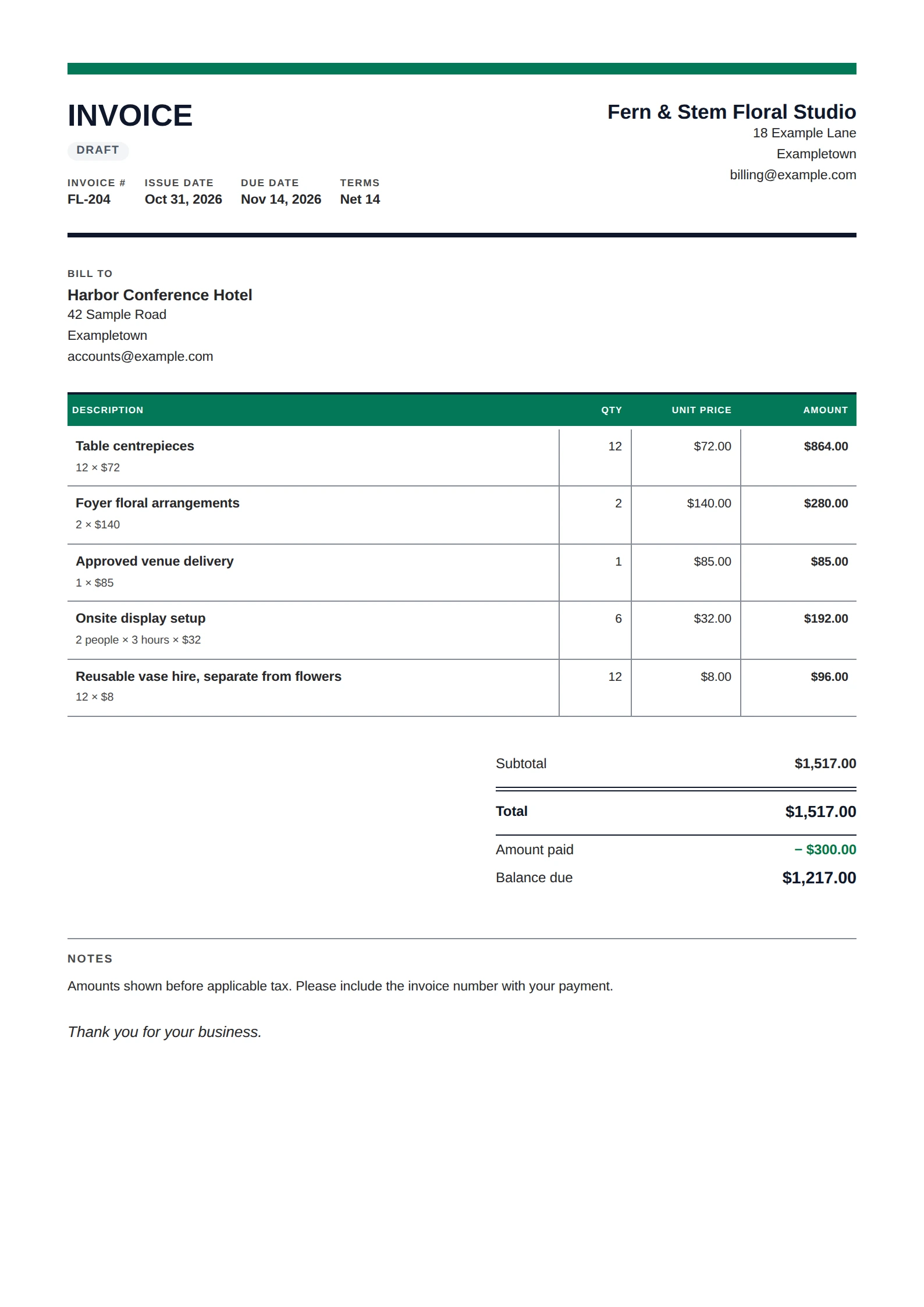
Imagine Fern & Stem Floral Studio supplies the fictional Harbor Conference Hotel for a one-day business event. Its approved order includes twelve table centrepieces, two foyer arrangements, delivery, two people for three hours of onsite staging, and twelve reusable display vases hired under an agreed return arrangement.
| Delivered goods or completed service | Unit calculation | Charge |
|---|---|---|
| Table centrepieces | 12 × $72 | $864 |
| Foyer floral arrangements | 2 × $140 | $280 |
| Approved venue delivery | 1 × $85 | $85 |
| Onsite display setup | 2 people × 3 hours × $32 | $192 |
| Reusable vase hire, separate from flowers | 12 × $8 | $96 |
| Total before applicable tax | $1,517 |
The figures are intentionally checkable. Twelve × $72 = $864; two × $140 = $280; two × three × $32 = $192; twelve × $8 = $96. Add $864 + $280 + $85 + $192 + $96 = $1,517 before any applicable tax. These US-dollar figures are invented solely to demonstrate invoice structure, not recommended florist prices, staff wages or regulated charges.
The vases are hired, not sold: the agreement should explain the return date, responsibility for loss or damage, and any valid separately agreed replacement fees. Do not assume the $8 hire gives the customer permanent ownership.
If the customer supplied its own vases, the $96 would not belong on this invoice. If only ten arrangements were delivered and accepted, do not quietly invoice twelve; correct the quantity or document the agreed resolution.
Suppose Fern & Stem received an evidenced $300 advance against the same order. The agreed pre-tax value remains $1,517, while the commercial pre-tax balance would be $1,217 after allocating that receipt. Tax treatment, timing and any adjustment still need a local review. NineBrief's deposit guide explains why paid-to-date and order value should not be confused.
 View full-size image
Created in NineBrief: USD 1,517.00 before applicable tax; USD 300.00 example advance; USD 1,217.00 balance due.
- Two people working three hours become six installation staff-hours.
- Vases are hired, not sold; return arrangements remain in the order records.
- Delivery and installation are distinct agreed charges.
What to do when stems or colours change
A florist may need to substitute flowers because a crop arrived late or a specific colour is unavailable. The original quote can state whether similar substitutions are allowed, what "equivalent" means and when approval is necessary.
For example, the hotel ordered twelve white-and-green arrangements. The florist proposes a different white flower of similar size and overall design and obtains agreement before production. The final invoice may still use the approved arrangement tier, with the substitution noted in a handoff record when appropriate.
If the customer refused a materially different arrangement, do not label the original product delivered and charge the full original amount without resolving the disagreement. Consumer rights and contract remedies vary by jurisdiction and sale type.
Keep a dated substitution approval record alongside the order and delivery acknowledgement. This protects the florist from disputes without putting every internal flower-stem purchasing decision on the customer invoice.
Treat perishable-goods cancellation rules carefully
Cut flowers are perishable, but "flowers are perishable" is not a blanket legal permission to keep any amount of money in any country or circumstance. Rights may differ for custom arrangements, rapid-deterioration goods, digital/telephone orders, service components and defective or misdescribed items.
The UK government's returns guidance identifies different refund circumstances for faulty, personalized and perishable goods. Its underlying Consumer Contracts Regulations provide conditional cancellation exceptions for goods liable to deteriorate rapidly and bespoke goods. Exceptions to a change-of-mind cancellation right do not erase the obligation to provide goods as described or respond appropriately to defects.
For event orders, the UK CMA's fair-contract guidance cautions against excessive charges and automatic loss of all prepayments. Evaluate preparation already performed, perishable stock genuinely committed, saved costs and contract wording; do not use a blanket "100% non-refundable" sentence without legal review.
Outside the UK, consult the relevant federal/state/provincial consumer rules. The examples here provide billing structure only, not a jurisdiction-wide ruling on cancellation remedies.
Separate rental and sale items after the event
A florist may rent vases, plinths, arches, buckets or other display pieces while selling only the floral arrangements. A clear invoice should identify that difference. Keep a return checklist showing which items were supplied, their condition, the agreed return date and any appropriately disclosed fee or deposit arrangement.
Do not silently charge a replacement fee because the hire period ended. Check whether the item is actually missing or damaged and whether the contract and local law permit the fee.
If the florist instead sells the vase outright with the arrangement, describe the combined sale accurately. A single item should not be both sold and hired to the same customer unless the parties specifically contracted for separate units.
Delivery shortages and revised quantities
Imagine the venue accepted eleven centrepieces but reported that one was missing. The florist should investigate, refer to the delivery notes and agree a remedy. The full twelve-item line is not automatically conclusive proof that twelve were received.
A corrected invoice might use eleven accepted units at the agreed unit rate, include a later replacement under a new delivery record, or reflect another lawful agreed settlement. Preserve the original order, the evidence and any issued correction rather than erasing the discrepancy.
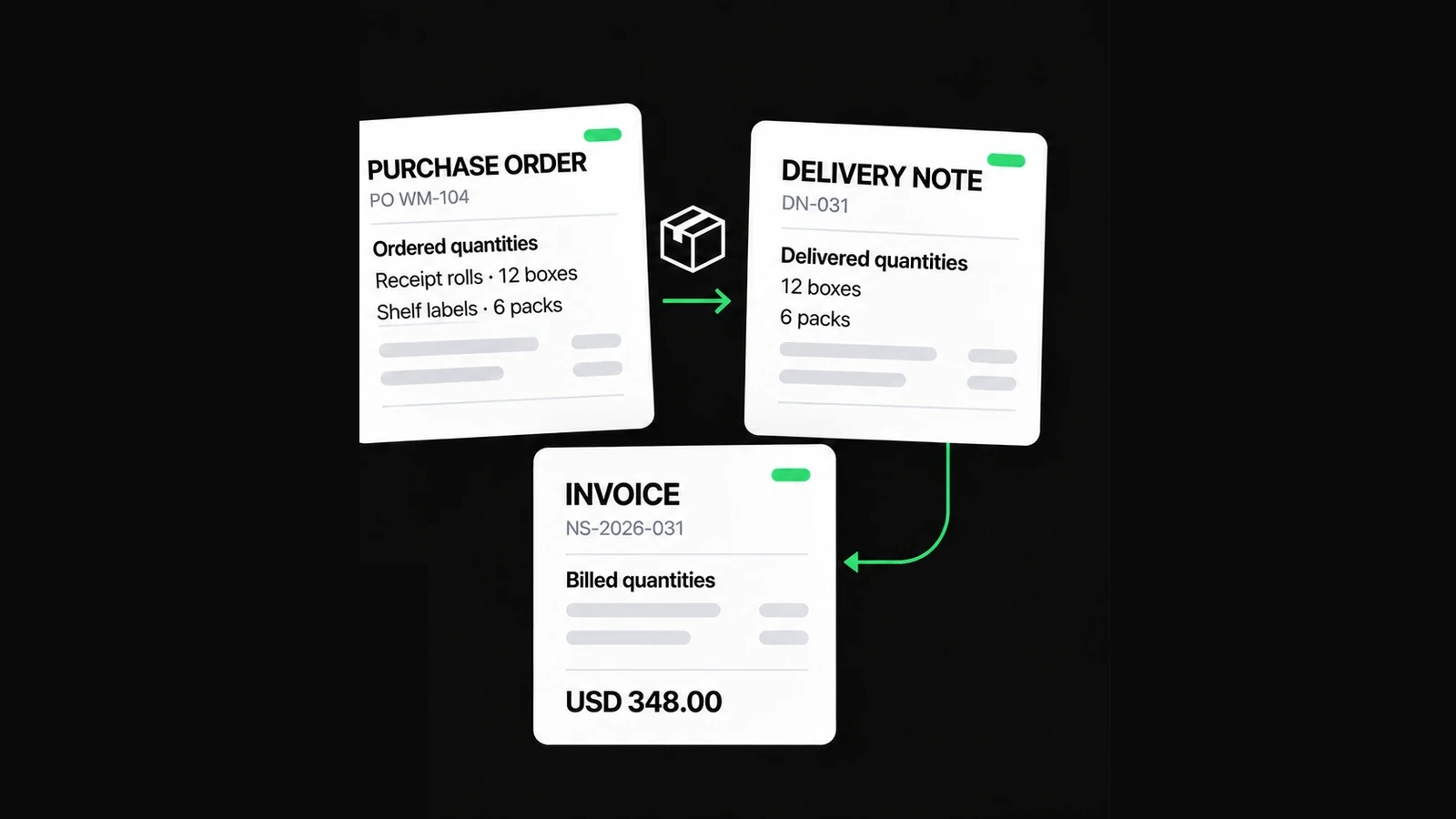
NineBrief's supplier invoicing example and purchase order/invoice/delivery note guide show why ordered, dispatched, received and billed quantities must stay distinguishable.
Tax and invoice information varies by market
Australian GST-registered businesses should follow the ATO's tax-invoice requirements, including the proper invoice identification and customer details when required. Canadian GST/HST treatment is explained by the CRA. In the UK, check general invoices and applicable VAT requirements. The IRS says US businesses should retain invoices, purchases and supporting receipt records.
Goods, installation, delivery and hire may have different or linked tax treatments under local law. Do not add a generic percentage to the example or assume floral goods are exempt because they perish. Verify seller registration, the nature of the supply and local customer details.
Create the florist bill with NineBrief
Open the Invoice Generator, enter the actual buyer and order number, set agreed dates and payment terms, and create distinct item lines for floral arrangements, delivery, onsite work and any hired vases. Check the twelve-unit and two-person multiplications and review the printed PDF.
The tool does not track stem inventory, reserve flowers, record supplier substitutions, manage delivery drivers, maintain vase deposits, confirm payment or automatically send emails. Use your order book, buyer approvals, delivery acknowledgements and receipt ledger alongside the invoice.
Florist invoice questions
Should delivery be a separate line?
Yes if separately agreed and chargeable. If already included in the arrangement package, do not bill it twice.
Can I replace a flower variety without telling the customer?
Follow the agreed substitution terms and applicable law. When a change is material, obtain appropriate approval and record it.
Do hired vases belong on the invoice?
They can, if the customer agreed to the hire and the charge is separate from the flowers. Preserve return and deposit records.
Are all floral orders automatically non-refundable?
No. Perishable and bespoke-goods rules vary, and statutory protections for faulty or misdescribed goods may still apply.
Does NineBrief manage flower deliveries?
No. It creates the customer invoice, not a dispatch or inventory system.
Florist invoice completion checklist
- Match order, buyer, approved product descriptions and actual accepted quantities.
- Separate arrangements from delivery, setup and reusable vase hire.
- Record substitutions and keep the delivery/handover notes.
- Distinguish deposits received from total sale value; do not infer payment.
- Apply relevant consumer/refund rights and locally applicable tax.
- Recalculate the $1,517 example model and export the customer-facing PDF.
About this resource
Product instructions are based on the current free-tool implementation; examples are synthetic and their arithmetic is checked. This is practical product guidance, not professional legal, tax or accounting advice.
For how the tools operate, see the Free Tools Terms of Use and Privacy Policy. Send corrections to hello@ninebrief.com without including confidential customer documents.