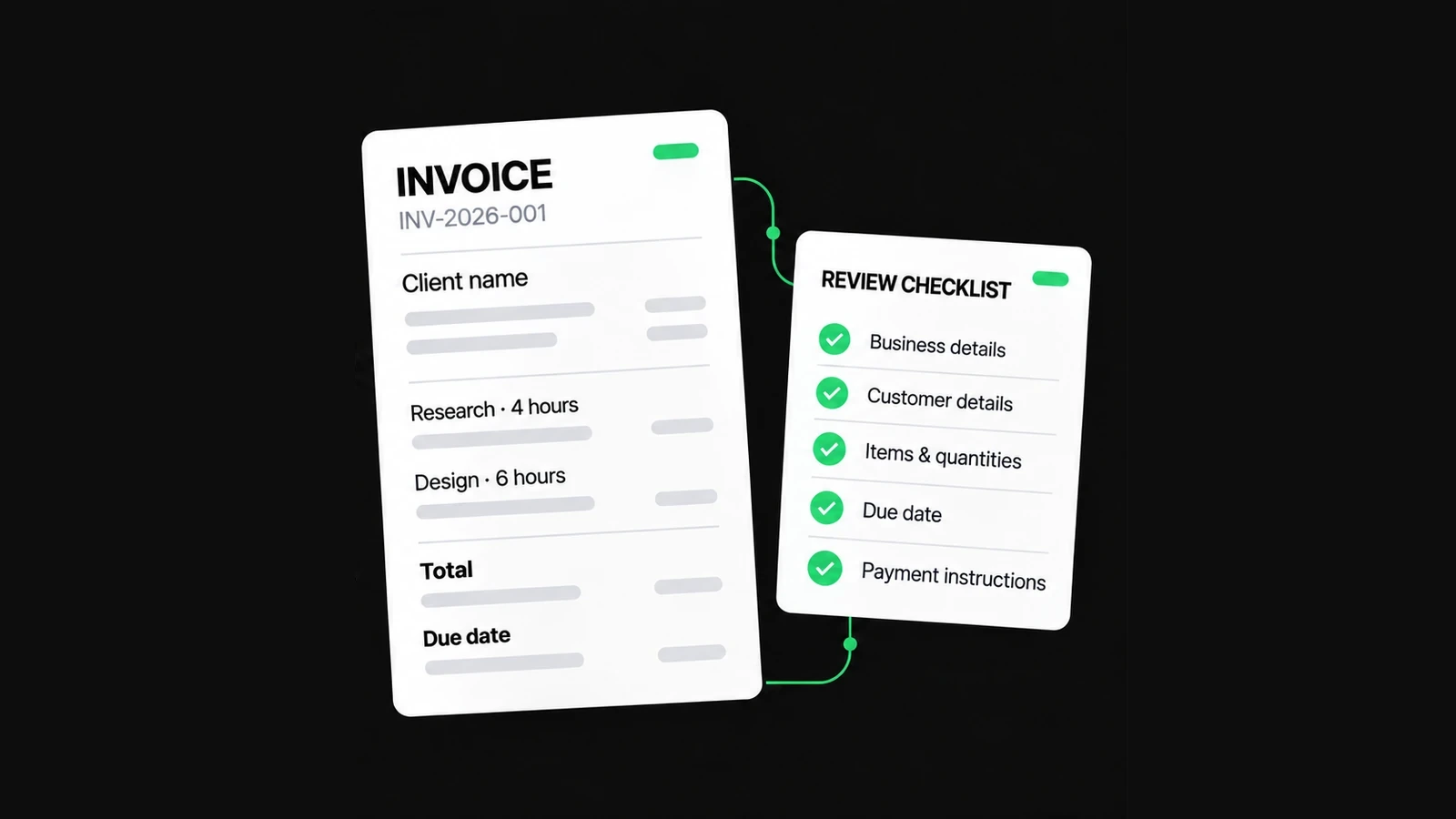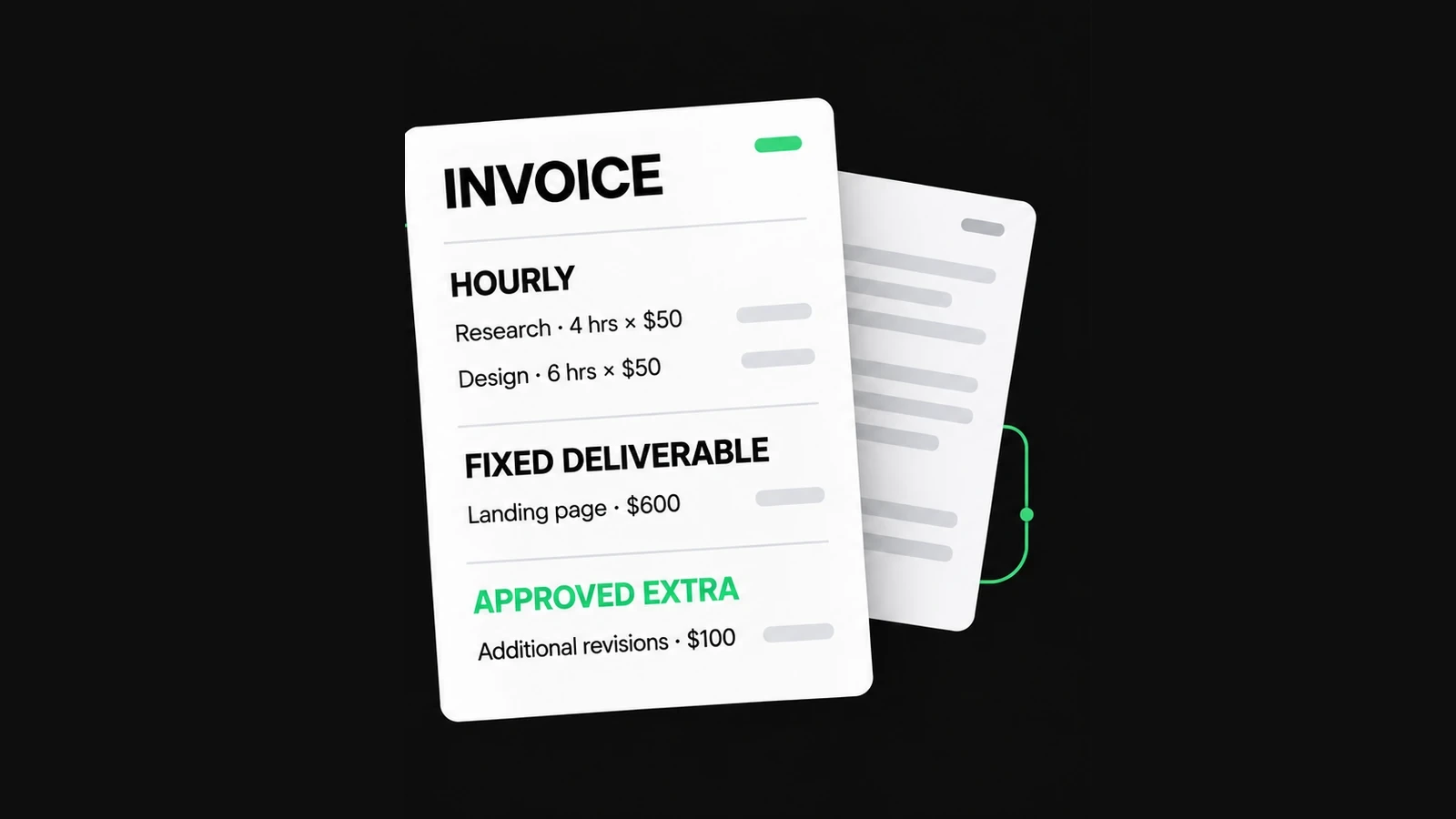

List the purchaser, agreed lesson period, session format, delivered dates or quantities, agreed rate and any authorized materials separately. Reconcile prepaid packages and rescheduled lessons with the lesson log so a cancelled or unused session is not accidentally billed as completed. Confirm locally applicable tax treatment and keep personal learning records outside ordinary invoices.
In this example
Start with the person or organization that agreed to pay
A tutor may teach an adult learner, deliver sessions for a parent, or be hired by a community organization. The learner and the payer are not necessarily the same person. Send the invoice to the person or legal entity named in the agreement instead of assuming that the person receiving lessons is automatically responsible for payment.
For a direct adult-learning arrangement, the learner may be both the customer and the recipient. For a tutoring centre, the centre may buy several lessons and later assign different learners. For a parent's purchase, keep the billing contact and only the minimum reference needed to reconcile the lesson. Do not publish learning assessments, disability information, home addresses, grade reports or children's full names in sample invoices or social artwork.
A simple reference such as "Autumn study support — agreement T-042" is often more useful than a private list of learners. Store session attendance, safeguarding permissions and educational notes separately in an appropriate record system.
Distinguish delivered lessons from reserved time
A lesson booked for Tuesday is not necessarily a lesson delivered on Tuesday. Reconcile the schedule, attendance notes and written agreement before producing a completed-service invoice. If a lesson was rescheduled, do not describe it as delivered on the original day. If a client missed the appointment, use the agreed and legally applicable cancellation or reserved-time treatment rather than silently changing its description to "tuition delivered."
The UK Competition and Markets Authority's guide to fair consumer contracts warns against cancellation charges or retained prepayments that exceed reasonable direct losses. It is UK consumer guidance, not a universal cancellation formula. A tutoring provider working in the US, Canada or Australia must check their applicable agreement and local consumer rules.
Make the billing period visible. A group lesson sold as one instructor session should not be multiplied by every learner unless the contract really sets a per-seat price. Separate these charging bases:
- One-to-one lesson: delivered sessions × agreed per-session price.
- Group workshop: number of delivered workshops × agreed workshop price, or enrolled seats × an explicitly agreed seat price.
- Prepaid package: a separate ledger of sessions bought, taken, rescheduled, remaining and refunded, not a blind new invoice for the entire package every month.
- Lesson preparation or materials: a separate amount only if it was within the agreed scope or approved as an extra.
Keep units descriptive: "6 × 60-minute tutorials" tells the payer more than "Education: $360."
Use a lesson log before an invoice
For each delivered session, a simple internal log can track the date, duration, format, approved rate and attendance or delivery status. It should also record who authorized an additional workshop or workbook and whether a session came from a prepaid package.
An efficient end-of-month reconciliation looks like this: compare the calendar with the lesson log; flag rescheduled sessions; check any messages approving extras; compare the number of delivered sessions with the contract; then prepare the invoice. Only enter the agreed chargeable units. The invoice is an output of that reconciliation, not the original record of what happened.
For privacy, the client-facing invoice can say "Six individual mathematics lessons, October programme" without exposing assessment marks or a child's learning profile. Preserve underlying educational records in their proper system with controlled access.
A checked $570 tutoring invoice
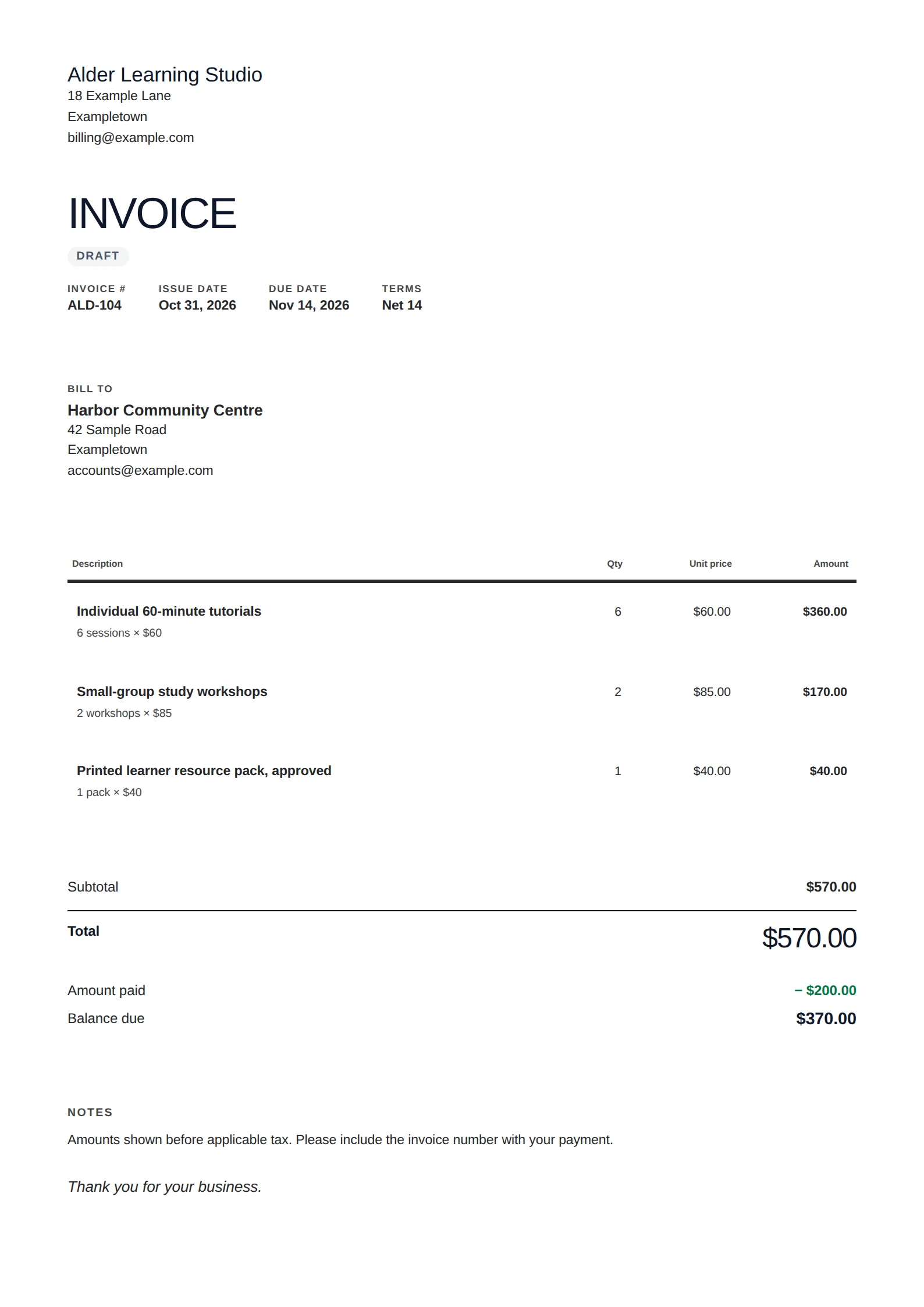
Consider a fictional adult-education provider, Alder Learning Studio, billing Harbor Community Centre for a completed instructional block. The centre ordered six individual tutorials, two small-group workshops and one separately approved printed-resource pack. All sessions took place; the resource pack was delivered.
| Completed work | Quantity and rate | Charge |
|---|---|---|
| Individual 60-minute tutorials | 6 sessions × $60 | $360 |
| Small-group study workshops | 2 workshops × $85 | $170 |
| Printed learner resource pack, approved | 1 pack × $40 | $40 |
| Total before applicable tax | $570 |
Check the arithmetic: 6 × $60 = $360; 2 × $85 = $170; and $360 + $170 + $40 = $570. The group-workshop fee in this fictional agreement is per workshop, not per learner. These are invented training prices for a calculation example, not typical local tutor rates, regulated fees or a recommendation.
The invoice might show agreement T-042, service period 1–31 October, invoice number ALD-104 and an agreed due date. The unit descriptions should align with the centre's accepted lesson log.
Imagine a seventh individual tutorial was booked but moved into November. It does not appear among the six delivered October tutorials. If the centre had prepaid $200 against this same teaching block, the total consideration remains $570 before applicable tax, but the commercial amount still to collect would be $370 if and only if that $200 has been received and correctly allocated. Preserve the payment receipt and allocation; do not present a fictional bank transfer as verified. NineBrief's deposit and balance guide explains that distinction.
 View full-size image
Created in NineBrief: USD 570.00 before applicable tax; USD 200.00 example advance; USD 370.00 balance due.
- Quantities count delivered lessons and workshops, not the number of learners.
- The approved printed resources appear as a separate item.
- The advance reduces the balance due without reducing the agreed total.
Prepaid lesson packages need a separate balance record
A ten-lesson package is not ten delivered lessons merely because the customer paid upfront. Keep a package record identifying the contracted sessions, delivery dates, cancellations, reschedules, unused balance and any refund or credit authorized under the agreement and law.
When invoicing a package sale, describe the package honestly as a prepaid entitlement if that is what the customer bought. When invoicing delivered individual sessions, describe only the sessions delivered. Avoid issuing a second completed-service bill for prepaid work without a reconciliation note.
Some tuition arrangements have different rules for expiry, substitution, non-attendance or refunds. Do not invent a universal "use it or lose it" policy, especially for consumers. Where refunds, credit notes or adjustments are needed, keep the original invoice and an appropriate correction trail rather than overwriting history.
Handle cancellations and make-up lessons transparently
Record who cancelled, when, whether the lesson had begun, whether a replacement was offered, and which contractual clause may apply. Distinguish a cancellation fee for reserved time from a completed lesson; they are different descriptions with potentially different legal or tax treatment.
A fair invoice could include "Late cancellation charge for reserved 60-minute session, per clause 4 and confirmed notice" only after checking that the term is fair, applicable and supported. If the parties instead agreed to reschedule with no extra fee, show the new delivery date and do not also charge for the old slot.
Australia's ACCC consumer-remedy guidance uses changes to music lessons as an example of a service variation that can trigger remedies. That is a reminder to distinguish an agreed in-person lesson from an unapproved switch to a different service; it is not a rate or refund calculator.
Keep subjects, materials and extra work intelligible
The line description should let the customer match work to a prior agreement. "English conversation coaching — four 45-minute sessions, 3–24 Oct" is clearer than "four classes." If materials are supplied at cost, explain whether they were included in the class price or separately approved. Do not invoice the same resource pack twice.
A tutor preparing an individualized learning plan should agree whether planning time is included in the session rate. If it is included, do not invent an additional planning fee at month-end. If the purchaser commissioned a stand-alone report or workshop, give it a separate deliverable, price and acceptance reference.
Be careful with terms such as "certified," "accredited," "exam guaranteed" or "learning outcomes achieved." Use them only if supported by genuine qualifications or records. An invoice records the purchased service, not a guarantee of the student's results.
Tax details change by country and provider
The legal invoice fields and taxation of tuition are not uniform. The UK government lists required standard invoice fields, including a unique number and descriptions. For VAT, HMRC's education guidance describes a conditional exemption for qualifying private tuition by individual teachers; it does not exempt every tutoring centre, online class, workshop or learning product. Later changes to private-school VAT are a separate regime and must not be merged into that rule.
In Australia, the ATO distinguishes GST-registered tax invoices from ordinary invoices. In Canada, the CRA specifies GST/HST invoice disclosures for taxable supplies. In the United States, state and local sales-tax treatment of education may vary; the IRS requires supporting invoices and receipt records, not a national tuition-sales-tax rate.
The $570 example deliberately excludes tax. Decide any actual tax treatment only after checking seller registration, service type, purchaser, place of supply and current local rules. NineBrief does not determine these matters on the tutor's behalf.
Prepare the invoice in NineBrief
Open the free Invoice Generator and enter the tutor's business details, the actual customer, reference, service period and agreed due date. Use the line-item controls to enter delivered sessions, workshop quantities and any authorized materials. Verify the arithmetic before printing or exporting the PDF.
The public tool supports preparing and exporting an invoice. It does not automatically ingest a lesson calendar, record attendance, manage lesson packages, bill subscriptions, send reminders or verify whether money has reached a bank account. Keep a separate attendance/package/payment record, and use the records guide for safe handoff.
If a client disputes a session, check the underlying agreed records. Correct the document through an appropriate documented process instead of declaring that a generated invoice proves attendance.
Common tutoring invoice questions
Should I list each lesson date?
A date range plus a clear quantity may suffice for a simple, agreed block; list individual dates or attach an authorized statement where the purchaser needs them. Avoid unnecessary learner identifiers.
Do I charge for a cancelled session?
Only if the agreement and applicable law support the charge. Describe reserved-time or cancellation charges honestly; do not relabel them as teaching delivered.
Can I invoice a package before teaching every lesson?
You can document an agreed prepaid package as a package sale when appropriate, but must keep the purchased balance distinct from completed lessons and follow any local tax and consumer rules.
Does NineBrief schedule tutoring invoices each month?
No. The public Invoice Generator is a manual document tool; it does not run tutoring subscriptions, lesson calendars or automatic monthly billing.
Before sending the completed invoice
- Address the invoice to the actual paying person or organization.
- Match the delivered quantity, dates and units to the agreed lesson log.
- Separate approved materials and workshops from tuition already included in a package.
- Check any cancellations or prepaid balances without double billing.
- Confirm required tax and customer details for the seller's jurisdiction.
- Recalculate the total, review the due date and preserve a copy and payment evidence.
About this resource
Product instructions are based on the current free-tool implementation; examples are synthetic and their arithmetic is checked. This is practical product guidance, not professional legal, tax or accounting advice.
For how the tools operate, see the Free Tools Terms of Use and Privacy Policy. Send corrections to hello@ninebrief.com without including confidential customer documents.