
Identify the client, shoot and booking reference, then list the agreed shooting, editing, deliverables, usage and approved extras without charging twice for included work. Show the full charges and subtract only payments actually received for the same bill. Payment timing, licence conditions and cancellation arrangements must follow the agreement and applicable law; they are not universal photography rules.
In this example
Start with the accepted booking
Before billing, gather the accepted scope, price, shoot date, client details and payment schedule. Identify who can approve extra time, retouching or broader image use. A conversation about possibilities is not the same as approval to charge for them. Keep the accepted version and later changes with the booking reference so the invoice can point to a clear record.
Agree what happens if the schedule changes, the client requests another location, weather prevents work or the booking is cancelled. The label deposit or retainer does not by itself establish that money is non-refundable. Do not introduce a cancellation fee or a payment-before-delivery condition for the first time on a final invoice. Its enforceability depends on the agreement and applicable law.
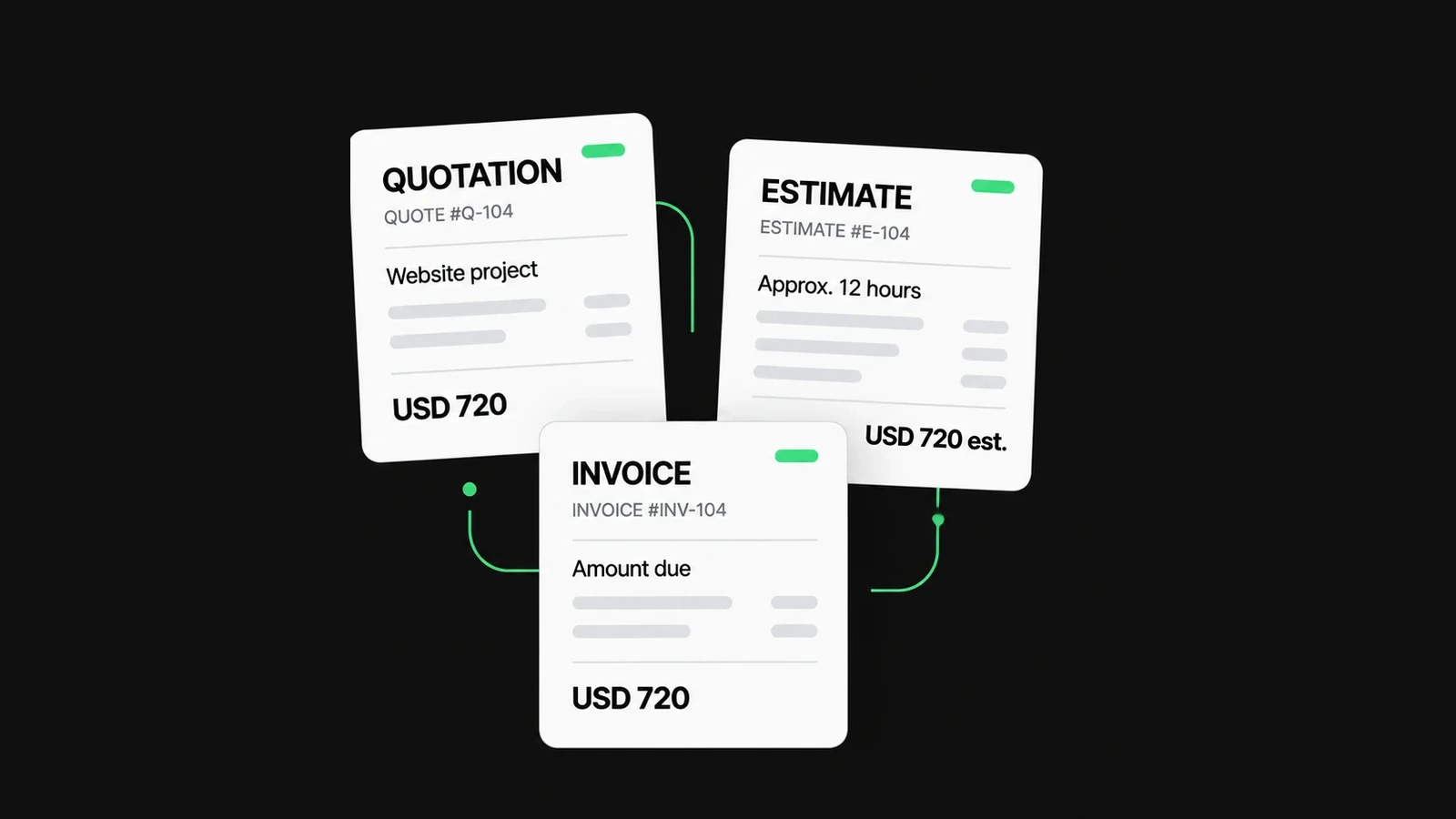
The quote, estimate and invoice guide explains the documents' different jobs. Australian guidance on preparing quotes is a useful official starting point for scope and conditions. Use it within its jurisdiction; it does not turn this sample workflow into a worldwide contract template.
Identify the shoot and the person who pays
The person directing the shoot may not be the customer named on the invoice. Confirm the legal or trading name used for billing, billing address, accounts contact and any purchase-order requirement. For agency work, clarify whether the agency or end client owes the fee. Do not change the payer just because someone else receives the final gallery.
Add an invoice number, issue date, due date, currency and booking reference. Describe the service date and location in enough detail for the client to recognize the assignment. Keep sensitive access instructions or private participant information in the operational brief rather than copying everything into the invoice.
The first-invoice guide covers general fields. For photography, a short project description such as commercial ceramics shoot plus a stable reference is often more useful than a long list of image filenames in every billing row. Keep detailed image selection and delivery manifests in the supporting project records.
Choose line items that match the price agreement
If the accepted price is a package, describe its inclusions and bill the package. If it is time-based, show actual chargeable hours and the agreed rate. Do not convert a fixed package into hourly billing after the shoot merely because the work took longer than expected. A clear invoice follows the agreed charging basis.
Separate shooting and editing when they are independently priced. Describe what editing includes: selection, colour adjustment, cropping, basic cleanup or a specified revision round. Extensive object removal, composites or additional retouching may be different work, but only charge separately when the scope and price support it. A line for included editing plus a second charge for the same editing is double billing.
State the deliverable count and format. Twenty finished images can mean twenty selected photographs supplied in both print and web sizes; that does not necessarily mean forty separately priced photographs. Clarify whether raw files, rejected shots, prints, albums or extended gallery access are included. Avoid using the broad word images when the client needs to know exactly what will arrive.
Describe agreed use without inventing rights
A useful licence summary identifies the images, permitted user, purpose or media, territory, duration and any exclusivity. Reference the accepted licence or agreement for the full terms. The invoice should make the billed permission recognizable without pretending that a short line replaces every legal condition.
For the fictional commercial example below, the agreed summary is: selected images from PHOTO-026, non-exclusive use by Alder Ceramics on its own website and organic social channels worldwide for 12 months from 2026-10-30; paid advertising, resale and third-party licensing excluded. This is an illustrative commercial choice, not recommended legal wording or a licence automatically supplied by NineBrief.
Paying for photography does not let you assume the same copyright outcome in every country or engagement. The US Copyright Office's photographer guidance describes general initial ownership and work-made-for-hire exceptions. UK ownership guidance distinguishes commissioned work, employment and agreements. Check the relevant law and contract before asserting who owns rights, particularly for Australian or Canadian assignments not governed by those sources.
Permission to use an image, copyright ownership and permission relating to people or property depicted are separate questions. A billed licence does not automatically settle model releases, privacy, trademarks or location permissions. If the client asks for broader use, obtain appropriate advice and agree the new scope before billing it as an extra.
Work through the complete fictional invoice
All names, rates and references here are invented. They are not customer evidence or recommended market prices. Lumen Field Studio photographs ceramics for Alder Ceramics under booking PHOTO-026. The accepted scope covers a studio shoot, editing of 20 selected images, a defined licence and agreed travel. Three of those same images later receive approved additional retouching; the final deliverable remains 20 images.
The shoot takes place on 2026-10-22. Final invoice PH-2026-041 is issued on 2026-10-29 and due on the agreed date 2026-11-12. The example includes no tax solely to isolate the arithmetic. In real work, determine applicable tax and required invoice information before calculating the total; photography is not universally tax-free.
| Description | Quantity | Rate | Amount |
|---|---|---|---|
| Commercial studio shoot, PHOTO-026 | 4 hours | USD 150.00 | USD 600.00 |
| Selection and standard editing for 20 images | 5 hours | USD 60.00 | USD 300.00 |
| Agreed non-exclusive image-use licence | 1 licence | USD 200.00 | USD 200.00 |
| Agreed travel charge | 1 trip | USD 45.00 | USD 45.00 |
| Approved extra retouching within the selected set | 3 images | USD 20.00 | USD 60.00 |
Check the rows first: 4 × USD 150.00 = USD 600.00; 5 × USD 60.00 = USD 300.00; 3 × USD 20.00 = USD 60.00. Then add USD 600.00 + USD 300.00 + USD 200.00 + USD 45.00 + USD 60.00 = USD 1,205.00. There is no discount and no separate charge for delivering the already-included files.
The description for extra retouching should reference the approved change, such as CHG-02, retained with the booking. Record which selected images it affects and what additional work was agreed. The invoice need not reproduce the entire creative conversation, but it should give the client a recognizable path back to the approval.
Reconcile the booking payment once
In this example, the studio confirmed receipt of USD 350.00 on 2026-10-08 under payment reference PAY-1008 and allocated it to PHOTO-026. The final summary therefore shows charges of USD 1,205.00, amount already paid of USD 350.00 and a balance due of USD 855.00. The check is USD 1,205.00 minus USD 350.00 = USD 855.00.
The payment is not a discount: it reduces the amount still owed, not the agreed value of the work. A requested booking payment that has not arrived must not be entered as received. Confirm the actual transaction and its allocation, including whether the payer intended it for this booking or another job.
This worked example uses a full-charge reconciliation with one payment against it. If you already issued a separate tax invoice for the booking amount, obtain the appropriate final-invoice or credit treatment for your jurisdiction and accounting system. Do not book both the full project total and an earlier deposit invoice as additional sales, or subtract the same payment twice. Keep the earlier document's reference visible.
Agree the due date and delivery timing in advance. Here, delivery is planned for 2026-10-30 and the agreed balance is due later; payment before delivery is not assumed. Other projects may have different accepted terms. The payment-terms guide explains how to make dates explicit without treating a preferred policy as a universal rule.
Keep travel and optional extras understandable
Use the travel method agreed for the assignment: a flat charge, a distance basis, actual approved expenses or inclusion in the package. The fictional USD 45.00 is a flat agreed charge, not a government mileage allowance or a recommended reimbursement rate. Keep receipts where relevant, and avoid adding both an inclusive travel package and the same costs again.
Treat extra shoot time, a second photographer, studio hire, rush turnaround and printed products as separate decisions. Record whether each is included, optional, approved or declined. Only approved chargeable work belongs on the final bill. A list of optional prices in the quote is not evidence that the client ordered every option.
For additional editing, distinguish a new creative request from correcting your own failure to meet the agreed deliverable. That distinction may require a conversation and reference to the contract. Explain the reason for a proposed charge before completing optional work, and keep the customer's acceptance. An invoice should summarize the result, not resolve an unspoken scope dispute.
Check tax and payment instructions before sending
Tax treatment can depend on location, registration, customer status and the mix of services, digital files, prints and licensing. Do not copy the example's no-tax assumption into a real bill. US state sales-tax treatment, UK VAT, Australian GST and Canadian GST/HST requirements are not interchangeable. Check the relevant official authority or a qualified adviser for your facts.
Show the currency clearly, especially for international clients. Agree who bears transfer or conversion costs rather than adding an unexpected fee later. Give verified payment instructions through your normal secure process. If bank details change, use a trusted verification channel; an invoice attachment alone should not be your only assurance that a change is authentic.
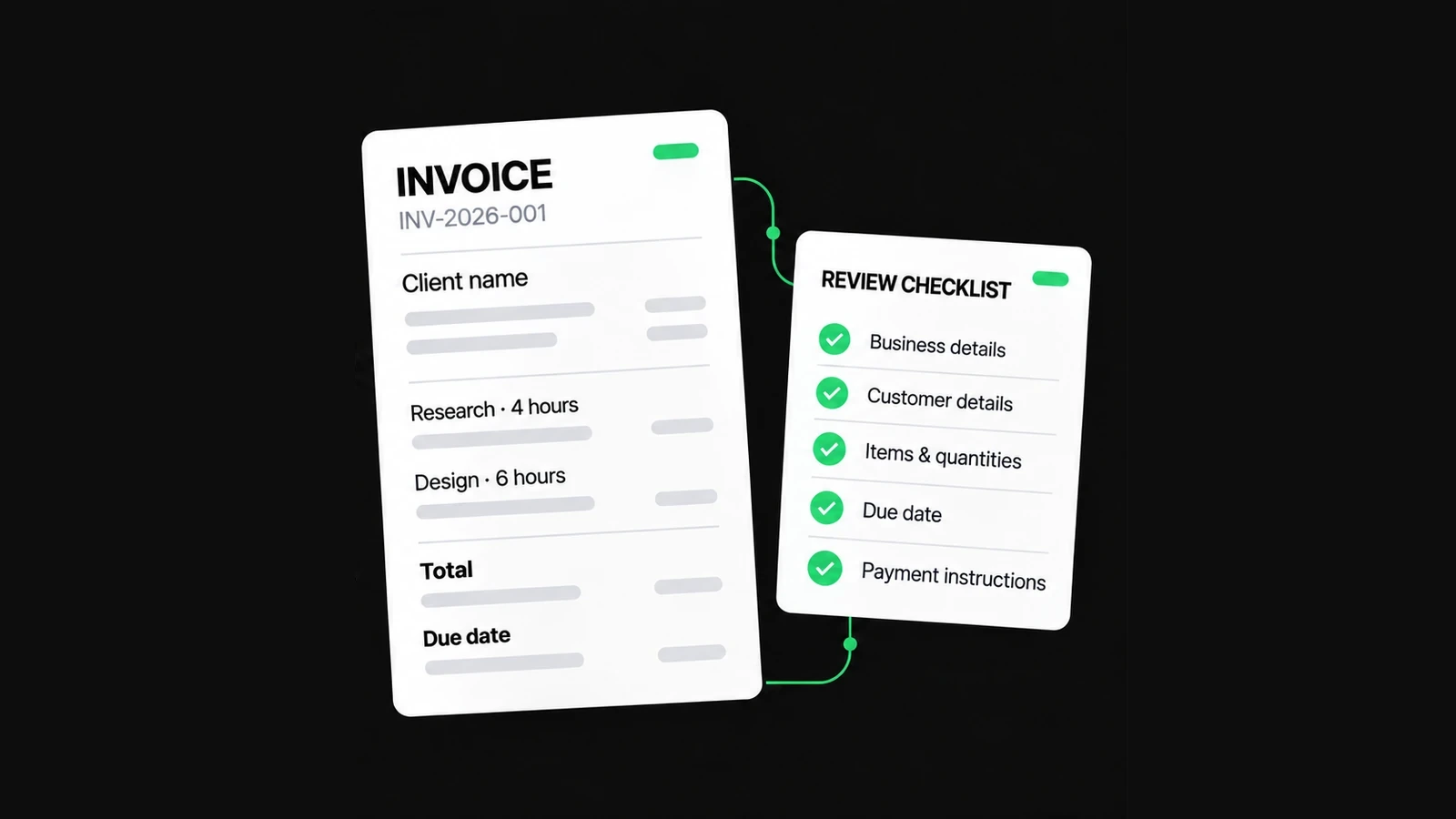
Before sending, open the final PDF and compare it with the accepted scope and payment evidence. Check the payer, project reference, dates, quantities, rates, licence summary and balance. A mathematically correct invoice can still be wrong if it names the wrong customer or charges for an option that was never accepted.
Record delivery separately from billing
Keep a simple delivery manifest stating what was supplied, when and through which agreed channel. For the example, the manifest can identify the selected set and the additional retouching without listing private download credentials on the invoice. Retain any client acknowledgement or issue report with the project.
| Record | What it says | What it does not establish |
|---|---|---|
| Final selected set | 20 edited images, including 3 with approved extra retouching | That every image taken was sold |
| Delivery record | Files supplied on 2026-10-30 through the agreed channel | That the balance was paid |
| Licence reference | Accepted use terms for the selected set | A universal copyright transfer |
| Payment allocation | USD 350.00 confirmed against this booking | Receipt of the remaining USD 855.00 |
File delivery and payment are related milestones, but they are not the same evidence. A sent gallery link does not prove that the client downloaded every file. A paid invoice does not by itself prove creative acceptance or that all permissions have been secured. Record each event accurately instead of using one Paid or Complete label to stand for all of them.
Save the bill and source before moving on
The released NineBrief Invoice Generator can create a readable PDF and export editable JSON. Review and save the PDF you intend to send, then retain the JSON for later editing. JSON is not the PDF and is not a payment receipt. Keep both with the booking, licence, approved changes and payment references in your own records.
The anonymous draft stays in the current browser. It is not an independent backup or a shared studio archive. Export important work before replacing a draft and keep a separate recovery copy under your control. The invoice and receipt organization guide provides a folder map, correction trail and monthly retrieval check.
Send the document through your own agreed channel and record the action. This workflow does not imply that NineBrief collects payment, delivers a gallery, schedules invoices, sends automatic reminders or tracks client views. Keep those operational steps separate from preparing the bill.
Review the invoice and common questions
- Confirm the billing customer, shoot date and accepted booking reference.
- Match shooting and editing charges to the agreed package or time basis.
- State the selected-image count, file formats and included revisions.
- Link the licence summary to the accepted usage terms.
- Include only approved travel and optional extras, without duplicates.
- Check applicable tax rather than assuming the example's treatment.
- Reconcile received payments once and verify the remaining balance.
- Save the exact issued PDF, editable source and delivery evidence separately.
Must every image be a separate line? No. Bill the agreed package or unit, and describe the included set clearly. Must editing always be extra? No. If it is included in the package, explain the inclusion instead of charging again. Are raw files automatically included? Do not assume so; follow the accepted scope and applicable rights.
Can you withhold delivery until payment? That is not a universal rule. Check the agreement and applicable law before relying on that condition. Does a deposit prove the final invoice is paid? No: show the amount actually allocated and the remaining balance. Does payment automatically transfer copyright? Do not assume it; the governing law, employment or commissioning arrangement and any valid transfer matter.
If the client disputes a line, identify the precise scope, approval or payment fact in question. Preserve the original bill and supporting records while resolving it, and use the appropriate correction process if a change is needed. The strongest invoice is one whose charges, payments and deliverables can all be traced to the same agreed assignment.
About this resource
Product instructions are based on the current free-tool implementation; examples are synthetic and their arithmetic is checked. This is practical product guidance, not professional legal, tax or accounting advice.
For how the tools operate, see the Free Tools Terms of Use and Privacy Policy. Send corrections to hello@ninebrief.com without including confidential customer documents.